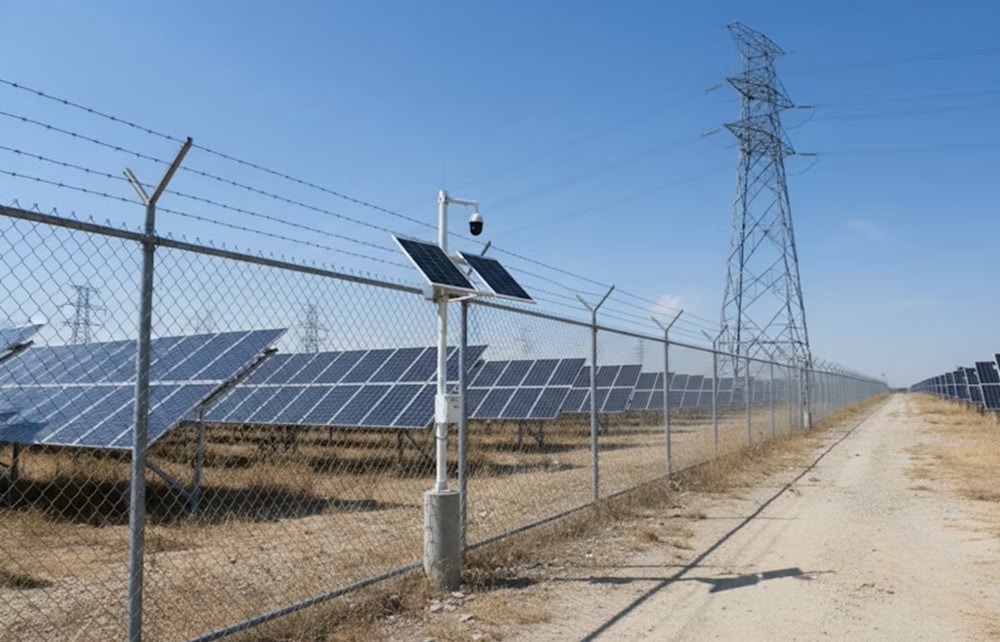
In recent years, solar farms have become prime targets for organised theft and security breaches, says OPTEX in a recent blog. Across Europe, incidents involving copper cable theft, vandalism, and unauthorised access are increasing year-on-year, with insurers and industry bodies reporting growing financial losses and longer operational downtime. As capacity and sites scale up, protecting these valuable assets is becoming more critical than ever. Staying one step ahead of evolving threats is no longer a security system design choice for solar farms; it is becoming a necessity.
Why cameras and CCTV systems are no longer enough:
- Many solar farm operators are still reliant on camera and CCTV-based systems as their primary line of defence. While cameras remain an essential component of any security setup, they were never designed to act as the only layer of detection. The limitations of these systems are becoming increasingly apparent:
- Detection vs. documentation: Cameras are reactive. While effective for documenting incidents after they occur, their ability to detect and prevent intrusions in real time is limited. By the time footage is reviewed, the damage may already have been done.
- Environmental challenges: The wide-open, exposed locations typical of most solar farms present unique challenges. Low light, fog, snow, hail, wind, rain, and glare from solar panels can degrade camera performance.
- Coverage gaps: Large solar farms require extensive coverage, and blind spots are common, particularly around perimeters or remote zones. Intruders can exploit these gaps to gain access undetected.
- False alarms: Wildlife, vegetation movement, or changing weather conditions can trigger frequent false alarms, overwhelming monitoring teams and in time, reducing confidence in the system.
The need for advanced perimeter protection
The high value of copper cabling and photovoltaic (PV) components makes solar farms particularly attractive to organised criminal groups. In the UK alone, thefts from solar farms have been linked to an estimated £7.1 million in losses, while multiple European incidents involving cable and inverter theft have individually exceeded €400,000 in damages. These losses result not only from stolen materials, but also from operational downtime, repair costs, and delayed energy production.
This raises the stakes for security managers and operators, who increasingly need to move beyond basic surveillance solutions.
Taking a multi-layered security approach
Solar farm operators face unique security challenges, including vast perimeters, remote locations, and high-value assets. While traditional camera systems have clear limitations, advanced detection technologies provide a smarter and more robust approach.
OPTEX’s award-winning REDSCAN Pro, a laser-based LiDAR solution, delivers high-precision virtual walls and detection zones, enabling instant breach detection with pinpoint accuracy. To achieve comprehensive protection, combining REDSCAN with fibre optic perimeter intrusion detection systems, such as OPTEX’s EchoPoint™ series, creates a best-in-class, multi-layered defence.
Precise, real-time detection: REDSCAN Pro monitors defined detection zones, while fibre optic sensors continuously monitor the fence line and ground beneath it, detecting vibrations from climbing, cutting, lifting, or digging attempts. This ensures threats are identified at the earliest stage.
Intelligent, customisable zones: REDSCAN Pro supports up to eight independently configurable detection zones, allowing tailored settings for high-risk areas or access points. Fibre optic systems protect extended or irregular perimeters and adapt to site layouts.
Weather resistance and night performance: LiDAR and fibre optic technologies are immune to poor lighting and adverse weather conditions, ensuring reliable detection 24/7.
Fewer false alarms: Both solutions focus on physical events rather than visual indicators alone, significantly reducing false alarms and allowing teams to focus on genuine threats.
Effective solar farm security starts at the outer perimeter with a layered approach. Combining REDSCAN’s targeted virtual walls with the continuous monitoring of fibre optic detection provides early warning and rapid threat identification. Fibre optic systems are ideal for long or complex perimeters, delivering uninterrupted coverage and instant alerts. When used in combination, these technologies provide scalable security that evolves with site requirements and regulatory demands.
Proactive response and proven compliance
Early and accurate detection allows security teams to respond before intruders reach critical infrastructure, reducing the risk of loss, downtime, and reputational harm. As compliance requirements tighten, deploying advanced detection technologies supports adherence to industry standards and insurance mandates, ensuring solar farms remain protected and insurable.
Setting the gold standard for solar farm security
As solar energy sites continue to expand in size, value, and strategic importance, security can no longer be treated as an afterthought. By adopting and combining proven solutions, such as OPTEX REDSCAN Pro and fibre optic perimeter detection technologies, operators can safeguard their assets, protect energy production, and stay one step ahead of emerging threats. Multi-layered perimeter security is not just best practice, it is the new standard for a resilient, future-ready solar energy sector.
For more OPTEX news, click here