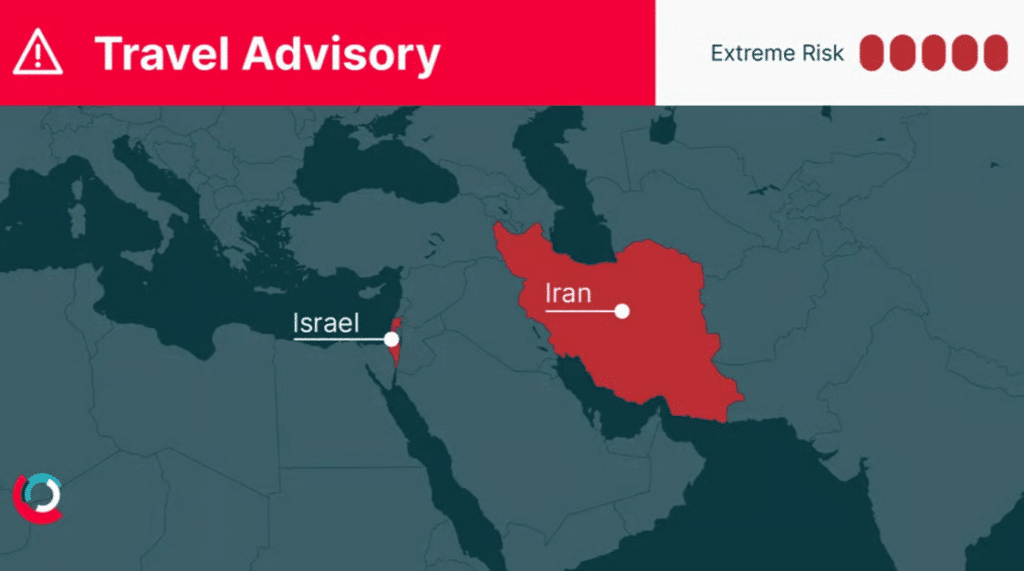
Safeture and Riskline analysts are monitoring developments in real time as the conflict between Iran, Israel, and the United States escalates across the region. On February 28, coordinated strikes between the United States, Israel, and Iran triggered a major regional escalation affecting security, aviation, and infrastructure across the Middle East.
Within hours:
- Missile and drone strikes were reported across multiple countries
- Airspace closures disrupted global aviation
- Regional security levels increased dramatically
According to intelligence from Riskline, both Iran and Israel are currently assessed at Extreme risk.
Latest Update — Day 5 of the Conflict
As the conflict enters its fifth day, the situation continues to affect regional security, aviation, maritime routes, and infrastructure across the Middle East.
Riskline analysts continue to monitor developments in real time, issuing alerts and updated guidance as the situation evolves.
Key developments
Drone and missile activity
A drone targeting the Ras Tanura oil refinery in Saudi Arabia’s Eastern Province was intercepted before causing damage. Multiple drones and missiles have also been intercepted across Saudi Arabia, reportedly launched from Iran, highlighting the continued risk to critical energy infrastructure in the region.
Airspace closures and flight suspensions
Air travel disruptions across the Middle East continue to expand:
- Syria: airspace closed until 8 March
- Iraq: nationwide closure extended until 7 March
- UAE, Saudi Arabia, Qatar and Kuwait: partial or full airspace closures remain in effect
Several international carriers — including Gulf Air, Etihad, Delta, El Al, Iberia Express and SriLankan Airlines — have suspended flights or adjusted routes.
Maritime security risks
The conflict is also affecting maritime security. An Iranian naval vessel, IRIS Dena, was struck off the coast of Sri Lanka, leaving over 100 crew members missing and dozens injured. The incident illustrates the widening risk environment across both air and sea routes connected to the region.
What happened
Coordinated strikes targeted several Iranian cities including Tehran, Isfahan, Karaj, Qom, and Kermanshah, triggering immediate retaliation.
Iran launched ballistic missiles and drones toward Israel and US military installations across the Middle East, causing explosions in multiple regional capitals.
Current impacts include:
- 555+ fatalities reported
- Nationwide internet disruptions in Iran
- Missile strikes across Israel
- Cyberattacks targeting communications infrastructure
The regional environment remains highly unstable.
Global Travel Impact
The conflict is already affecting international aviation.
- 11,000+ flights grounded
- 1.5 million passengers affected
- Airspace closed across several Middle Eastern countries
- Major airlines rerouting flights between Europe and Asia
- Israel’s Ben Gurion Airport is operating only limited repatriation flights.
- For organizations with traveling employees, disruptions are likely to continue.
How Safeture and Riskline responded
As the crisis unfolded, Safeture delivered continuous intelligence updates powered by Riskline’s global analyst network.
Since the first strikes:
- 601 alerts published globally
- 342 alerts related to the Middle East
- 399 alerts related to aviation disruptions in the region
- Regional advisories for Iran and Israel
- Country advisories for UAE, Qatar, Bahrain, Kuwait, Saudi Arabia, Jordan and Cyprus
- Verified reporting from local authorities and media
Riskline analysts verify information through local authorities, aviation sources, media reporting and regional intelligence monitoring before alerts are distributed.
All intelligence is delivered directly through the Safeture platform, enabling organisations to:
- Track developments in real time
- Identify employee exposure
- Communicate rapidly with affected staff
- Support informed operational decisions
“Our team is closely monitoring developments in Iran, Israel and the wider region in real time. We provide verified, location-specific intelligence across airspace, cyber and ground security domains.”
Roxana Dumitrescu
Analyst, Riskline
Why Real-Time Intelligence Matter
Global crises escalate quickly. Without access to real-time intelligence, organizations may struggle to:
- Identify employee exposure
- Monitor rapidly changing risks
- Communicate with traveling staff
- Respond effectively to incidents
Safeture helps organisations stay ahead of global risk with:
✔ Real-time alerts
✔ Global risk intelligence
✔ Employee location awareness
✔ Crisis communication tools
Protect Your People Anywhere In The World.
When crises escalate, timely intelligence makes all the difference.
👉 Book a Safeture Demo
When a Crisis Hits, Communication Becomes a Risk of its Own
In a crisis, communication is often assumed to be the simplest part of the response: “We’ll send a message.”
But conflict zones do not follow normal operations. Networks get congested, infrastructure is damaged, power failures occur, and sometimes connectivity is intentionally limited. Consequently, the most critical messages are often the hardest to send.
The current escalation involving Iran, Israel, and the United States is a clear reminder that communication infrastructure can become unstable or unavailable within hours.
Connectivity is not guaranteed
In late February 2026, monitoring groups reported a near-total internet blackout across Iran. National connectivity dropped dramatically following military escalation and cyber activity. For a period, tens of millions of people were effectively cut off from digital communication.
At present, it can sometimes be difficult to reach several other countries in the region because the telephone networks are down for longer or shorter periods due to the ongoing conflict.
Why single-channel communication fails
Communication disruptions in crisis environments typically fall into three categories:
Physical damage: Fiber lines, switching stations, and cell towers are vulnerable in conflict zones. Restoration can take days or longer.
Intentional shutdowns. Governments increasingly use internet restrictions as a security or control measure during unrest or escalation.
Network congestion and cyber disruption: Even when infrastructure remains intact, traffic spikes and cyber activity can significantly degrade performance. An SMS marked as “sent” does not guarantee delivery.
In the past week alone, Safeture has sent more than 20 times as many SMS alerts and recommendations to the Middle East region as usual.
For organizations with people in affected regions, relying on one channel — whether SMS, email, or a messaging app — creates a single point of failure.
The Operational Impact
When communication fails, organizations lose real-time visibility of employees, rumors spread faster than verified information, and duty-of-care obligations become harder to fulfill.
In volatile situations, minutes matter. Communication delays increase risk exposure, both operationally and reputationally.
Redundancy is a risk mitigation strategy
Resilient crisis communication requires layered delivery:
- Multiple channels (app, SMS, email, voice)
- Data-based and carrier-based routing
- Two-way communication and status confirmation
- A centralized, verified source of information
The objective is not absolute certainty. It is increasing the probability that critical information reaches the right people at the right time.
Increasing the probability of delivery
No technology can override a nationwide blackout. However, a pre-installed safety application like Safeture significantly increases the likelihood of successful communication when partial connectivity is available.
Push notifications may work when SMS routing is delayed.
In-app alerts can reach users when data traffic is available but voice channels are congested.
Two-way check-ins provide real-time status confirmation rather than assuming silence equals safety.
Most importantly, a single trusted platform reduces misinformation during rapidly evolving events.
This is why employees should download and activate the Safeture app before travel, not during a crisis. Preparation removes friction when networks are already strained.
Communication is part of your risk landscape
The ongoing tensions in the Middle East demonstrate a broader principle: connectivity is not constant. In conflict zones, it is dynamic and vulnerable to disruption.
Organizations that treat communication as a guaranteed utility increase their exposure. Those who treat it as a risk factor and build redundancy into their crisis response strengthen their resilience.
In high-risk environments, silence is not neutral. It is an operational risk.
The question is not whether networks may fail.
The question is whether you prepared before they do.
Contact [email protected] or visit Safeture.com for more information on how we can help your organization to protect what matters most – your people
Incident Timeline: How the Escalation Unfolded
28 February — Coordinated Strikes Begin
- In the morning hours (around 09:45 Tehran time), coordinated United States–Israeli airstrikes targeted several Iranian cities including Tehran, Isfahan, Karaj, Qom and Kermanshah.
- Multiple waves of strikes hit government facilities and strategic infrastructure.
- Within hours, communications disruptions were reported across Iran, including internet and telecommunications outages.
28 February — Iranian Retaliation
Iran responded by launching ballistic missiles and drones toward Israel, striking locations including Tel Aviv, Haifa and Beit Shemesh.
At the same time, US military bases across the Middle East were targeted, including installations in:
- United Arab Emirates
- Bahrain
- Kuwait
- Qatar
- Saudi Arabia
Explosions were reported in several regional capitals, prompting shelter-in-place orders and airspace closures.
1–2 March — Regional Impact Expands
As hostilities continued, the conflict began affecting regional infrastructure and global travel.
Key developments included:
- Airspace closures across Iran and Israel
- Significant disruptions to Middle East aviation routes
- Heightened security alerts across several Gulf states
- Increased cyber activity targeting communications and media infrastructure
- By 2 March, Riskline analysts had issued over 320 alerts globally to track developments and warn affected regions.
3 March — Aviation Disruptions Spread Globally
The aviation sector began experiencing large-scale disruptions.
Current impact:
- 11,000+ flights grounded
- 1.5 million passengers affected
- Airspace closed across several Middle Eastern countries
- Airlines worldwide rerouting flights between Europe and Asia
Repatriation flights from Israel are expected to operate only in limited capacity, while many airlines have suspended regional services.
4 March — Day 5: Regional Security Risks Expand
Missile and drone interceptions continued across Saudi Arabia, including an attempted attack targeting the Ras Tanura oil refinery.
Airspace closures across Syria and Iraq were extended, while several Gulf states maintained partial airspace restrictions, continuing to disrupt global aviation routes.
Maritime risks also increased following an attack on the Iranian naval vessel IRIS Dena near Sri Lanka, demonstrating the expanding geographic scope of the crisis.
Why Situational Awareness Matters
Events like this escalation show how quickly global crises can unfold.
Within just a few days, the situation evolved from targeted military strikes to widespread regional disruption affecting aviation, infrastructure and international travel.
Organizations with employees traveling or operating in the region need real-time intelligence to respond quickly and protect their people.
Through Safeture’s platform, verified intelligence from Riskline analysts is delivered directly to organizations and their employees, enabling them to monitor developments, communicate with staff, and make informed decisions immediately.
Find out more, here
For more Middle East news, click here