Proton has announced the launch of Proton Workspace, a suite of business productivity tools to compete with widely used offerings from Google and Microsoft.
While Proton, like Google, started as a consumer company and has attracted over 100 million users looking for an alternative to the Google ecosystem, it has also been successful at attracting businesses.
Today, Proton counts over 100,000 enterprise customers across its ecosystem of products, which includes Proton Mail, Calendar, Drive/Docs/Sheets, VPN, password management, and Lumo, its privacy-first AI.
While Proton’s enterprise customers initially adopted individual products to address specific needs, an increasingly large number are now adopting the entire Proton ecosystem. This shift has driven the development of Proton Workspace, a consolidated offering that unifies all services into a single, cohesive bundle.
“We see that businesses are increasingly adopting ecosystems instead of individual products and services, and we’re hearing more from customers, particularly those wary of Big Tech’s data practices, that they want a secure, bundled alternative that matches the ease of migration and integration of Google or Microsoft, but without the privacy trade-offs. The launch of Proton Workspace is the next evolution of our business offerings to meet the needs of these customers,” said Andy Yen, Founder and CEO of Proton.
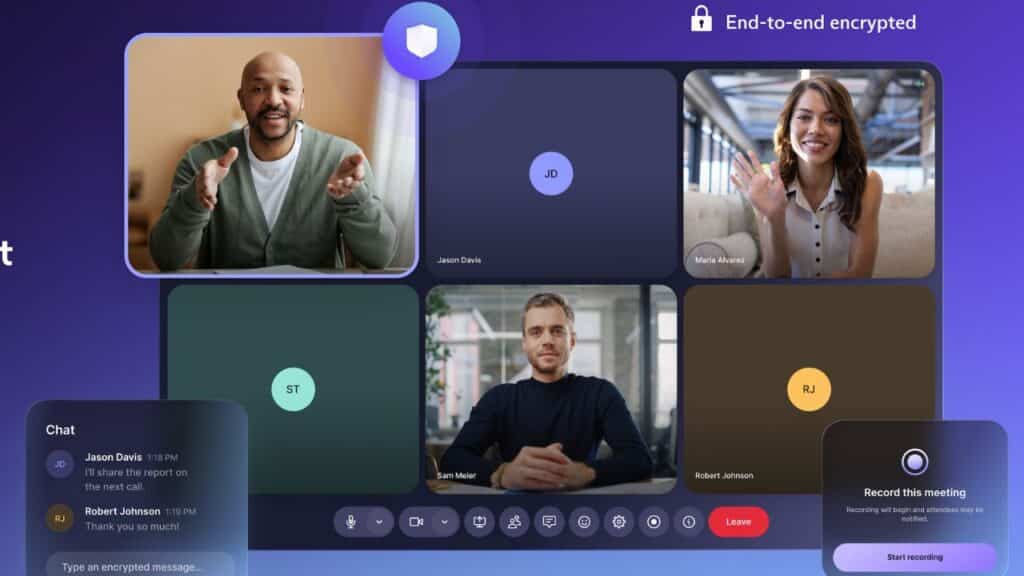
Together with Proton Workspace, the company is launching Proton Meet, an encrypted video conferencing solution that fills a key gap in Proton’s productivity ecosystem. Proton Meet is a video conferencing solution not dissimilar to Zoom, but with two key differences.
First, all video calls and chats in Proton Meet are end-to-end encrypted by default using the new Messaging Layer Security (MLS) encryption protocol.
This gives Proton Meet a level of security unmatched by any other video conferencing service today. With Proton Meet, the confidentiality of conversations can be assured even if Proton’s infrastructure is compromised.
Second, Proton Meet can be used anonymously and keeps no logs, and a Proton account is not even necessary to host or join meetings, making it an ideal tool for dissidents and activists seeking the highest level of privacy.
“In today’s digital world, privacy shouldn’t be an optional extra; it should be the default for every conversation,” said Andy Yen. “Whether you’re talking to a doctor, hosting a business meeting, or checking in on your kids, you rightly expect these interactions to be private and safe by default. Unfortunately, the dominant players like Google Meet and Zoom simply do not offer these assurances. That’s where Proton Meet comes in, combining privacy with convenience.”
As tech giants pivot to AI, they are now processing audio, video, and chat data. Depending on shifting privacy policies, this data could be used to train AI models, creating a real risk that fragments of private conversations could leak or resurface in future AI-generated outputs. Proton Meet’s end-to-end encryption also safeguards against these risks.
“Companies are increasingly worried that their confidential business data is becoming business intelligence for Big Tech and turning to safer alternatives. In particular, we see strong demand for Proton’s Lumo AI, which also leverages strong encryption that ensures that we cannot read your AI history and that your confidential information cannot inadvertently leak, while still allowing companies to reap the productivity benefits of AI,” said Andy Yen.
For more information about Proton Workspace, please visit Proton’s dedicated blog article.
To read more security news, click here.