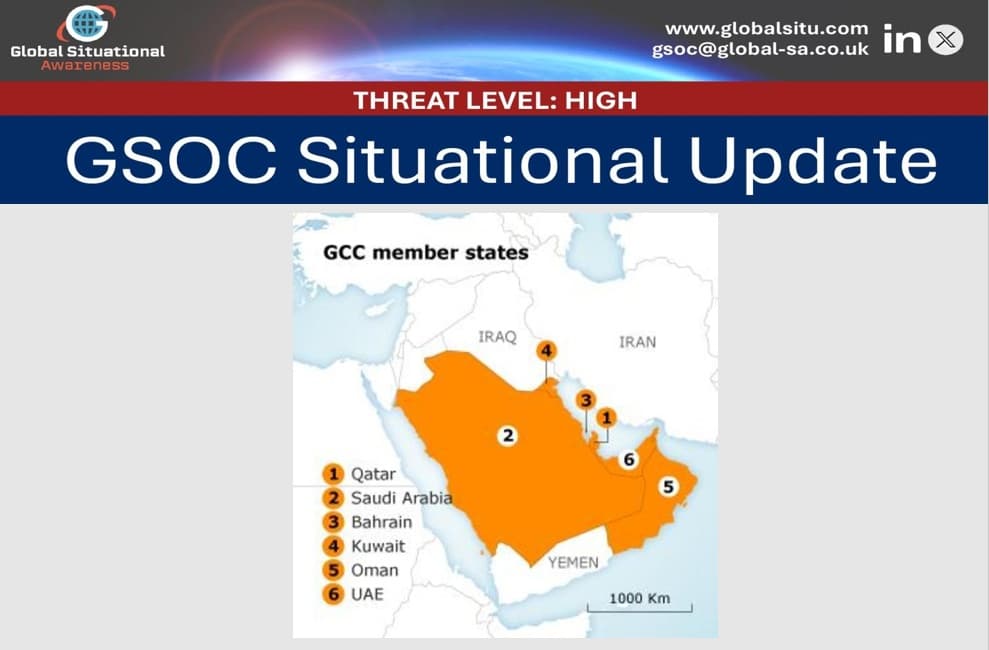
Global Situational Awareness has released a Global Weekly Review of goings on around the world, covering the action in the Middle East, as well as Pakistan and Afghanistan, Cuba and US, Columbia and North Korea. Below, we bring you an extract of the report – a situational update and assessment and impact of the Iran, Israel, US action, and the full report is downloadable below.
US and Israeli military operations against Iran have entered a sustained and expanded phase, with strikes continuing across multiple strategic locations including Tehran, Isfahan, Bushehr and Tabriz. Coalition forces have targeted military command facilities, air defence systems, missile infrastructure and naval assets, significantly degrading elements of Iran’s conventional capability.
US Central Command has stated that more than 1,200 targets have been struck since operations began, including Iranian naval vessels operating in the Gulf of Oman. Iranian leadership messaging has hardened, framing the confrontation as existential and warning that regional bases, shipping routes and coalition-aligned infrastructure remain legitimate targets. Iran has continued missile and unmanned aerial vehicle launches across the Gulf region, targeting military installations and critical infrastructure.
The Strait of Hormuz has become a focal point of escalation, with Iranian Revolutionary Guard elements issuing warnings over maritime radio frequencies that transit is prohibited. While no formal legal closure has been declared, traffic volumes through the strait have dropped sharply, creating a de facto denial environment. Electronic warfare activity and GPS interference near Bandar Abbas have further complicated commercial navigation.
Domestically, Iran’s internet connectivity has remained severely restricted for more than 48 hours. Information blackouts have historically accompanied internal security operations, limiting visibility into protest activity, internal dissent and regime cohesion during periods of instability.
Assessment and Impact
Iran’s strategic posture suggests a deliberate effort to impose significant economic and security costs on coalition-aligned states and global markets while sustaining its own defensive coherence. Targeting the Strait of Hormuz and surrounding maritime approaches is intended to leverage Iran’s geographic advantage over global energy supply routes, with the potential to exert prolonged pressure on crude, LNG, and freight markets.
The interception by Qatar of Iranian fighter aircraft signals a broader involvement of Gulf states in kinetic engagements and underlines the operational risks of multi-national sorties in contested airspace. The operational environment remains highly volatile and prone to miscalculation. Incidents such as the friendly-fire downing of US aircraft by Kuwaiti air defences during active defence operations highlight the complexity and risk inherent in a busy, multi-layered air defence landscape.
Continued Iranian retaliation, including maritime drone attacks, missile barrages, and proxy actions by aligned militias, increases the likelihood of wider spillover effects. The degradation of navigation integrity in the Strait of Hormuz and the absence of reliable insurance coverage for transits have created a de facto chokepoint denial environment, with significant implications for global energy logistics. Internally, the combination of wartime measures and an extended internet blackout complicates assessments of regime stability, public sentiment, and elite cohesion, and may serve to reinforce centralised control at least in the near term.
Download the full report, below
For more Middle East news, click here