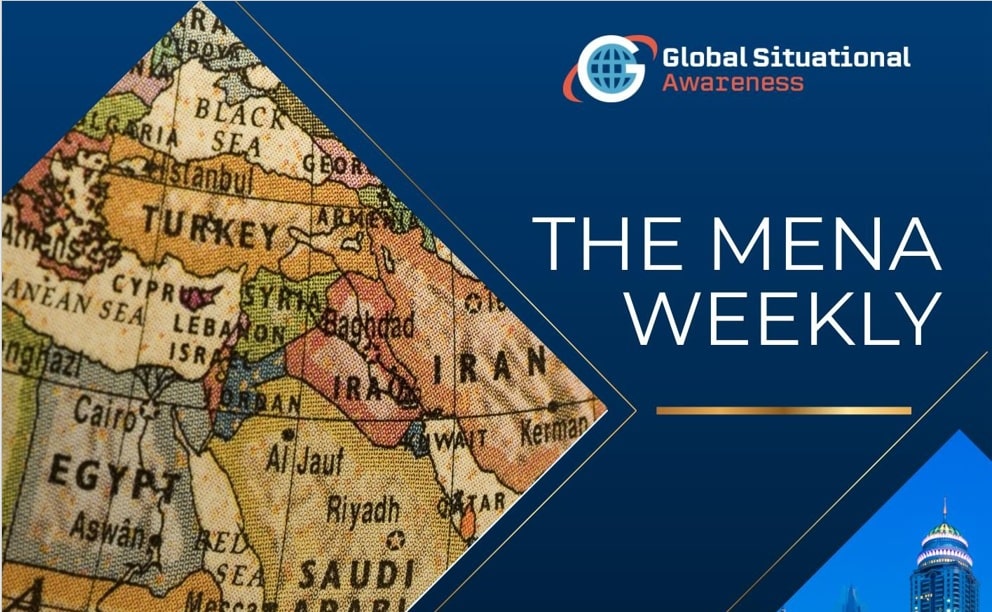
In its latest MENA Weekly briefing for the week ending Friday, August 14, Global Situational Awareness details all the latest developments in the Middle East region, including in Saudi Arabia, where Iraq has appeared to take limited steps to prevent further Iranian-backed militia attacks against Saudi Arabia and other regional states, in Yemen, where Houthi attacks on Saudi energy infrastructure are widening escalation risk, and Iran-Oman arrangement raises freedom-of-navigation questions, plus much more. This is an extract, with the full piece available for download, below.
Militia disarmament moves risk preserving Iranian-backed influence — HIGH
Situation Update
On 8–10 August 2026, Iraq appeared to take limited steps to prevent further Iranian-backed militia attacks against Saudi Arabia and other regional states, but the structure of those steps raises concern that militia power may be preserved rather than dismantled. Iraqi officials who met a Saudi intelligence delegation on 8 August reportedly pledged to prevent the use of Iraqi territory for attacks against Saudi Arabia and asked for information that could help stop future strikes. The engagement suggests Baghdad is trying to avoid further retaliation against Iraq while signalling to Riyadh that it can restrain armed groups operating from Iraqi territory.
On 9 August 2026, an Iraqi political source said militias would hand over their weapons to the Popular Mobilisation Forces before the federal government’s 30 September 2026 disarmament deadline. That deadline coincides with the planned withdrawal of US-led coalition forces from Iraq. However, the PMF itself contains many Iran-aligned militias and is led by actors with close ties to Tehran. Transferring weapons into the PMF would therefore risk moving militia capability into a state-recognised structure that Iran has heavily infiltrated rather than placing it under genuinely independent federal control.
The issue is further complicated by reported attacks and covert command structures. Security and intelligence sources speaking to Saudi media said Iranian-backed militias may have carried out a drone strike on 2 August that destroyed shells for US-provided Iraqi tanks and armoured vehicles at Camp Taji. Separately, US-funded Arabic-language media reported additional details of IRGC-linked cells operating through small groups of Iraqi fighters who maintain a low profile and bypass formal militia leadership.
Assessment/Impact/Business Implications
For businesses, the immediate risk is that Iraq’s disarmament process becomes cosmetic rather than substantive. If weapons move from militias into the PMF without meaningful command reform, Iraq may appear to be complying with state-control demands while preserving armed networks capable of threatening Saudi Arabia, Iraqi Kurdistan, US-linked facilities and domestic opponents. This would keep security risk elevated for energy firms, logistics operators, contractors and foreign investors.
The Camp Taji incident is especially concerning because it suggests some militias may be attempting to weaken the Iraqi military’s ability to act against them. If true, this points to a direct contest over state coercive power. It also raises the risk that military facilities, US-supplied equipment and coalition-linked infrastructure could remain targets during the disarmament period.
The overall risk remains high because Baghdad is trying to balance Saudi pressure, Iranian influence, militia resistance and the coalition withdrawal timeline. Companies should monitor whether the 30 September deadline produces real disarmament, PMF consolidation, or renewed attacks designed to pressure the Iraqi state before US-led forces leave.
Yemen – Houthi attacks on Saudi energy infrastructure widen escalation risk – HIGH
Situation Update
On 9–11 August 2026, Houthi attacks on Yemen’s government-held port city of Mokha and Saudi-linked energy infrastructure widened concern that the Red Sea conflict is again moving beyond maritime harassment into a broader regional escalation cycle. Yemen’s military said the Houthis had resumed attacks on Mokha, a strategic Red Sea port city held by forces opposed to the group. The renewed strikes are significant because Mokha sits close to Bab Al Mandeb, where attacks can affect both Yemen’s internal conflict and wider commercial shipping confidence.
At the same time, Houthi attacks have increasingly targeted Saudi energy assets and Red Sea-linked infrastructure. The group’s strikes are part of a broader escalation against the Yemeni government, Saudi Arabia and shipping routes connected to the Red Sea. Recent coverage of the Mokha attacks and wider reporting on Houthi action against vessels, government-held areas and Saudi-linked targets show that the threat environment remains multi-layered.
The strategic risk is that the Houthis are using simultaneous pressure on ports, vessels and Saudi energy infrastructure to demonstrate reach and complicate alternative export routes. This matters because Saudi Arabia has relied on Red Sea routes as a partial hedge against Hormuz disruption. If both Hormuz and the Red Sea become unstable at the same time, regional energy resilience weakens significantly.
Assessment/Impact/Business Implications
For businesses, the immediate risk is renewed pressure on Red Sea shipping, Bab Al Mandeb transit, Saudi energy infrastructure and Yemen-linked port operations. Shipowners, charterers, insurers and energy companies may face higher war-risk costs, tighter routing controls, crew concerns and more restrictive vessel-acceptance criteria. Even where attacks do not close routes, they can slow decision-making, delay cargoes and raise the cost of operating near Yemen.
The Saudi dimension is particularly important. If Houthi strikes against energy facilities become more frequent, Saudi exports and refinery operations may face greater security costs and contingency-planning requirements. The attacks also undermine confidence in Red Sea alternatives at the same time as Hormuz remains politically contested. That creates a connected chokepoint risk across two major maritime theatres.
The overall risk remains high because Houthi activity is not confined to one target set. Attacks on Mokha, vessels and Saudi-linked infrastructure create a broader escalation environment in which commercial operators cannot separate Yemen’s civil war from regional energy security. Businesses with exposure to Red Sea shipping, Saudi western infrastructure or Yemen-adjacent logistics should maintain elevated monitoring and flexible routing options.
Download the full piece, below
For more Middle East news, click here