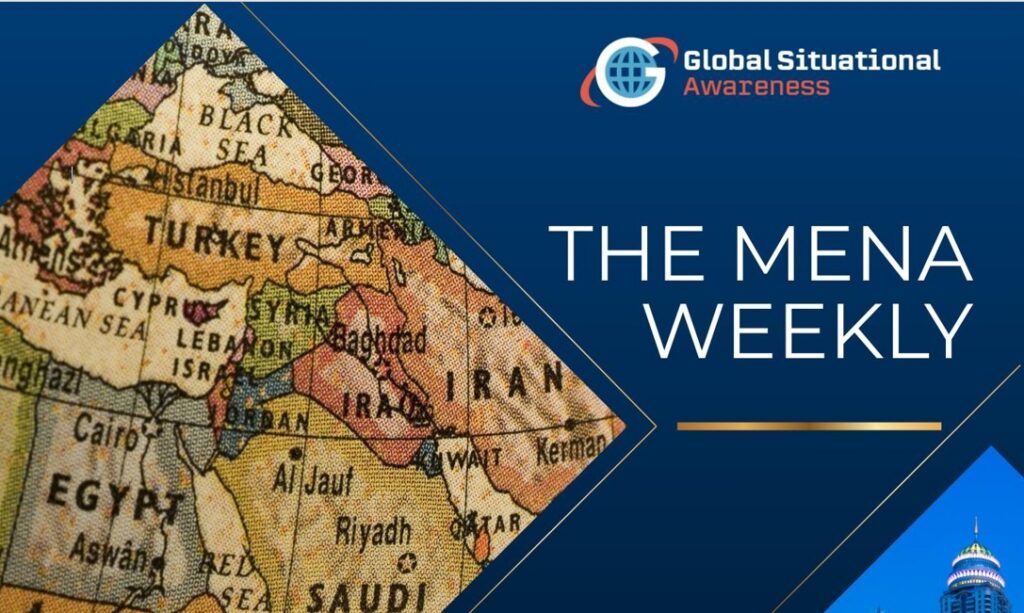
In its latest MENA Weekly briefing for the week ending Friday, May 15, Global Situational Awareness details all the latest developments in the Middle East region, including Trump’s comments about the ceasefire with Iran being on “life support” after rejecting proposal, Saudi Arabia and UAE’s covert attacks on Iran, Kuwait’s accusation that Iran launched a failed attack on the island, Israeli troops who have been jailed for desecration of Virgin Mary statue in Lebanon, and finally, the discovery of a major oil field in Najaf, Iraq.
Below is an excerpt, with the full piece available for download.
Iran — Trump says ceasefire with Iran on “life support” after rejecting proposal — SEVERE
Situation Update
On 11 May 2026, United States (US) President Donald Trump stated that the ceasefire agreement with Iran was on “life support” and claimed that he was considering restarting US Navy military escorts of ships through the Strait of Hormuz. His comment came a day after he rejected Iran’s response to a peace proposal, which he labelled “totally unacceptable” in a Truth Social post. The disputed terms included Iran’s demands for an end to the fighting on all fronts, sovereignty over the Strait of Hormuz, the lifting of the US blockade, financial reparations, the lifting of sanctions, the release of billions of frozen Iranian assets, and binding guarantees against future attacks. Similarly problematic were Washington’s requirements for Tehran to dismantle its nuclear programme and transfer its stockpile of highly enriched uranium.
The ceasefire deal between the two countries came into force on 07 April 2026. However, it came under heavy strain last week after Washington launched Project Freedom, resulting in Iran launching a wave of attacks on US warships and commercial trade vessels in the Strait of Hormuz, as well as targets in the United Arab Emirates, Kuwait, and Qatar. The fallout included a strike on a South Korean commercial vessel, damage to the Fujairah Oil Zone refinery in the UAE, and the sinking of seven Iranian fast boats by the US, which also launched massive airstrikes inside Iran targeting drone/missile infrastructure.
Assessment/Impact/Business Implications
With so many disputes over the terms of a potential agreement, the two sides appear to be at an impasse. However, it remains in neither side’s interest for the status quo to be prolonged. For Iran, Washington’s blockade on all Iranian ports has cut off the country’s greatest source of revenue and forced the nation to find new ways to store excess oil that it cannot sell. Should existing storage fill up and force production shut-ins, there will be a significant risk of permanent structural damage to underground reservoirs. For the Trump administration, concerns exist domestically regarding the legality of a resumption in fighting, given that a US president must receive Congress’ approval within 60 days of notifying lawmakers of military action. While US Defence Secretary Pete Hegseth has argued that Trump does not need such approval, maintaining that the ceasefire had paused any such obligation, the situation remains unpopular. This could be politically consequential with midterm elections scheduled for November 2026.
Saudi Arabia/UAE/Iran — Saudi Arabia and UAE launched covert attacks on Iran — SEVERE
Situation Update
According to two Western officials and two Iranian officials, Saudi Arabia launched numerous, unpublicised strikes on Iran in late March 2026. They have been interpreted as a retaliation for attacks carried out in the kingdom during the Middle East war, marking the first time that the kingdom is known to have directly carried out military action on Iranian soil. When requested for a response, a senior Saudi foreign ministry official did not directly address the matter. In a similar fashion, new reports have also claimed that the United Arab Emirates (UAE) has secretly carried out military strikes on Iran. This included a strike on Iran’s Lazan Island just before the 07 April 2026 ceasefire was announced.
Relations between Saudi Arabia and Iran, two regional powers suspicious of each other, have traditionally been frosty. With both nations backing a number of opposing proxy groups in Yemen, Lebanon, Syria, and Iraq, the strategic situation has been labelled as the New Middle East Cold War. Nevertheless, relations had improved in recent years following a Chinese-brokered diplomatic détente in March 2023, which restored formal diplomatic ties and reopened embassies. However, after Iran launched attacks across the Middle East in response to the beginning of United States (US)-Israeli military operations in Iran on 28 February 2026, bilateral ties once again deteriorated. Relations between the UAE and Iran have historically fluctuated between intense geopolitical rivalry and deep economic dependency.
Assessment/Impact/Business Implications
Despite Saudi Arabia’s reliance on Washington for military protection, the war with Iran has left the country vulnerable, with waves of Iranian attacks piercing through the kingdom’s air defence system. The situation has been consistent across the Gulf Cooperation Council (GCC) states, all of which have been targeted with missiles and drones. Iran has launched more strikes against the UAE than any other nation, reflecting the country’s status as a regional economic hub and the severe diplomatic hostility to Iran expressed by its rulers. Riyadh and Abu Dhabi’s retaliation demonstrates the widening of the conflict as well as the two countries’ ongoing strategic interest in seeing Iran weakened. Reports in March 2026 indicated that Saudi Crown Prince Mohammed bin Salman had urged Trump to ramp up attacks against Iran.
The strikes illustrate a heightened risk of GCC states becoming embroiled in a direct war with Iran than previously thought. Although the fact that the attacks have not been comprehensive or publicised demonstrates some restraint, likely from fear of such an outcome. Notwithstanding, the revelation of their role is likely to make the pair even clearer targets for Iran if the ceasefire is abandoned and the fighting restarts. It is likely that Tehran will use the revelations as justification for continued intervention when it deems it necessary.
Download the full piece, here
For more Middle East news, click here