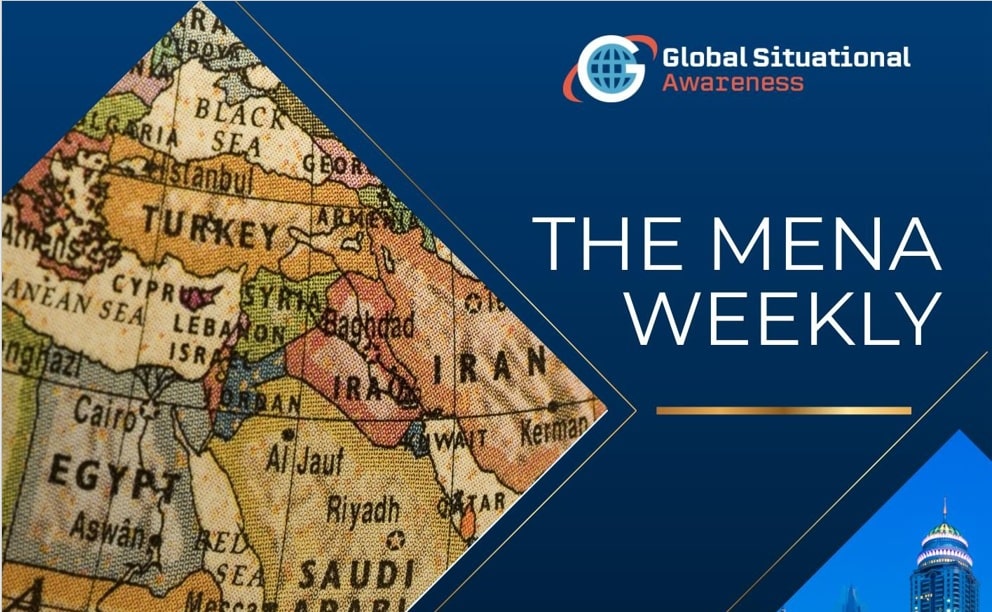
In its latest MENA Weekly briefing for the week ending Friday, May 29, Global Situational Awareness details all the latest developments in the Middle East region, including the US and Iran exchanging attacks, the internet beginning to return in Iran after some months-long blackout, the remnants of Assad’s chemical weapons programme being recovered in Syria, Israel pounding Lebanon with strikes and ground operations, and more. Below is an extract with the full piece available for download.
Iran — US and Iran exchange attack – Severe
Situation Update
On 25 May 2026, the United States (US) launched a new wave of attacks on southern Iran, targeting Iranian missile sites and boats attempting to place mines. According to a statement published by US Central Command (CENTCOM), the strikes were in “self-defence” and designed “to protect our troops from threats posed by Iranian forces”. The attacks targeted an area near Bandar Abbas, a southern port city and home of an Iranian naval base that sits on the Strait of Hormuz. The following day, the Islamic Revolutionary Guard Corps (IRGC) claimed it had downed a US drone and fired at a fighter jet and another drone that entered Iranian airspace. Then, on 28 May 2026, the IRGC released a statement claiming it had struck a base used by US forces to conduct the attack near Bandar Abbas Airport. However, details regarding the location of the base were not provided. Later on the same day, the US said a missile shot by Iran towards Kuwait had been successfully intercepted.
Assessment/Impact/Business Implications
The latest escalation casts doubt on the negotiations between the two sides for a peace agreement. While neither country has stated that the ceasefire has collapsed, the situation is becoming increasingly dangerous. Despite the attacks, US President Donald Trump has reiterated his desire to make a deal happen. Although escalating rhetoric further illustrates the differences between the two countries; Iranian Supreme Leader Mojtaba Khamenei has asserted that the Middle East “will no longer serve as shields for US bases”. While US Secretary of State Marco Rubio has again stressed that Iran’s actions regarding the Strait of Hormuz are “illegal”.
With it being over 50 days since the US-Iran ceasefire came into force on 08 April 2026, Trump is in an unenviable position. Pivoting between escalation and diplomacy appears to be a deliberate strategy to try and break the strategic deadlock at a time when the dual blockades remain in place in the Strait of Hormuz. With the European Union warning that the jet fuel market is set to “become increasingly tighter” if disruptions continue in the coming weeks, pressure is likely to grow on Trump to agree to a deal with favourable terms for Iran. Although with questions regarding how much oil storage capacity Iran has left before facing costly shutdowns of its oil fields, pressure on Tehran is also growing. The situation creates a balancing act whereby Trump must consider the growing political and economic consequences of the war and the closure of the Strait, while Iran weighs the economic concerns and their potential knock-on impacts for the regime.
Iran — Internet starts coming back after months-long blackout — SEVERE
Situation Update
Internet access has begun to return in Iran after an unprecedented nationwide blackout that lasted 88 days, the longest national shutdown of its kind on record. The restoration remains partial and heavily controlled, with connectivity still well below normal levels and many major platforms continuing to face restrictions. Reports indicate that some residential users and selected mobile networks in Tehran have seen services resume, while broader access remains uneven and heavily filtered. Officials have described the process as a phased and regulated restoration rather than a full reopening.
The move is significant because the blackout had become one of the clearest signs of the Iranian state’s willingness to use digital isolation as a tool of wartime control and domestic repression. The shutdown devastated the digital economy, cut off communication with the outside world, and left many households, workers, and businesses operating in conditions of prolonged uncertainty. At the same time, the restoration does not amount to a return to the pre-blackout environment. Access remains heavily restricted, and key services still require workarounds such as VPNs, while the authorities continue to favour a model in which connectivity is granted selectively and under state supervision.
Assessment/Impact/Business Implications
For businesses, the partial restoration is positive in the narrow sense that it may gradually improve communications, payments, logistics coordination, and access to customers after months of severe disruption. However, the key takeaway is that Iran’s digital environment remains unstable, politicised, and vulnerable to renewed restrictions at short notice. Firms with exposure to online commerce, digital services, cross-border communications, or remote operations should not treat the return of connectivity as a restoration of normal conditions. The blackout demonstrated how quickly the state can sever access, while the current phased reopening shows that the government still intends to control the terms of digital participation.
The overall risk remains severe because the restoration is taking place within a system that has not fundamentally changed and the security situation remains extremely dangerous. Iran is emerging from a prolonged period of digital isolation, but the infrastructure of control remains in place and the state’s preference for regulated, selective internet access is becoming clearer. Any renewed unrest, security incident, or escalation in the regional conflict could quickly lead to new restrictions or another large-scale shutdown.
Download the full piece below
For more Middle East news, click here