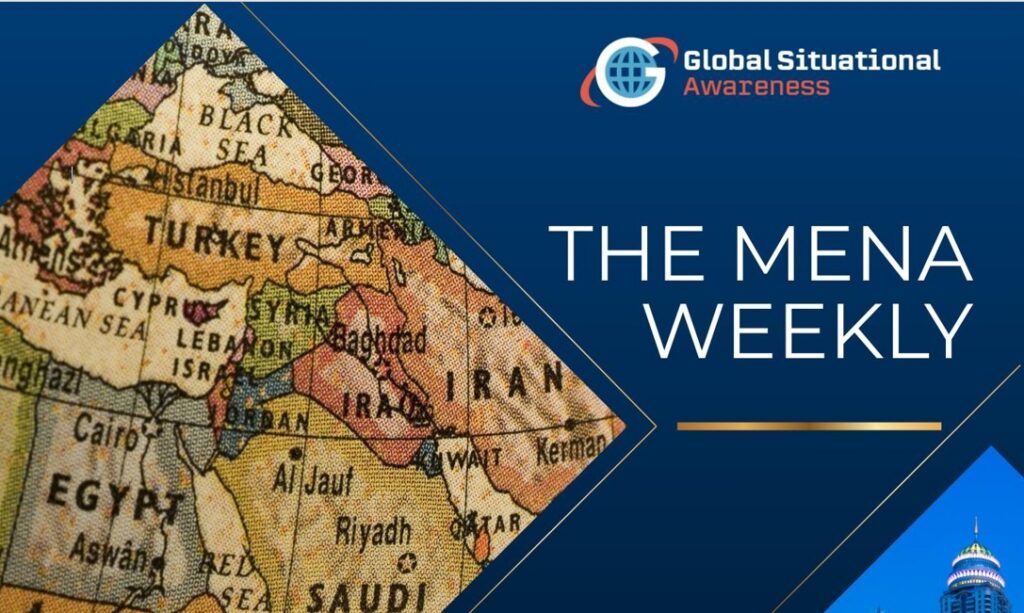
In its MENA Weekly briefing for the week ending March 17, geopolitical intelligence risk advisory firm Global Situational Awareness focuses on the latest developments between Iran and the US, where peace talks have collapsed in Pakistan, the US military blockade of vessels trying to enter Iranian ports, which has now come into effect, Israel escalating strikes on Lebanon as Hezbollah rejects talks, and a journalist detained in Kuwait over Iran war social media posts. Below is an extract, with the full piece available for download.
US/Iran peace talks in Pakistan collapse – SEVERE
Situation update
On 12 April 2026, United States (US) Vice President JD Vance stated that 21 hours of peace talks between the US and Iran in Islamabad had failed to produce an agreement to end the war. Mediated by Pakistan, the negotiating session was the highest-level face-to-face encounter between US and Iranian officials since Iran’s 1979 Islamic Revolution. Vance was joined by Special Envoy Steve Witkoff and US President Donald Trump’s son-in-law, Jared Kushner. The Iranian delegation included Foreign Minister Abbas Araghchi and the speaker of Iran’s Parliament, Mohammad Bagher Ghalibaf.
Key areas of discussion included the Strait of Hormuz, Tehran’s nuclear programme, war reparations, the lifting of sanctions, and an end to the various conflicts in the Middle East. While Israel was not involved in the talks, the Israeli Defence Forces (IDF) have not struck Iran since the ceasefire was reached, although they have continued to strike targets in Lebanon. Despite the talks failing to produce a diplomatic breakthrough, the fact that the speaker of Iran’s Parliament met with Vance remains extraordinary, given the long history of animosity between the two nations.
Assessment/Impact/Business Implications
The collapse of the negotiations suggests that the two parties remain far apart on a number of issues. For a peace agreement to be achieved, it is important that both sides can save face from whatever deal emerges. On 14 April 2026, Trump suggested that talks aimed at ending the war in Iran could resume this week. One day later, Pakistan’s army chief arrived for talks in Tehran on the possibility of a new round of negotiations. Although with Washington imposing a naval blockade on Iran, doubts have grown over the prospects for a two-week ceasefire that is due to expire next week. More than a dozen US warships and some 10,000 US military personnel are now enforcing the blockade against vessels of any country entering or leaving Iranian ports, starving Iran of a vital economic lifeline. Nevertheless, at the time of writing, efforts to revive negotiations appear to be gathering pace, with reports suggesting that the two sides have been in indirect talks aimed at extending the two-week ceasefire beyond its expiry on 22 April 2026. Much hinges on whether a diplomatic pathway can be discovered. Failure risks a resumption in fighting that could lead to further infrastructural damage across the region, another spike in fuel prices, as well as mass displacement and casualties, among other consequences.
Iran — US military blockade comes into effect — SEVERE
Situation update
On 14 April 2026, the United States (US) began enforcing its blockade on vessels calling at Iranian ports. The move was announced by US President Donald Trump after weekend peace talks in Islamabad between the US and Iran failed to produce a deal. Reports on the first day of the blockade suggested that it had made little difference to traffic through the Strait of Hormuz, with at least eight ships, including three Iran-linked tankers, crossing the waterway. However, on 15 April 2026, the US military announced that it had “fully implemented” its blockade and that economic trade entering and leaving Iran by sea had been “completely halted”.
In retaliation, Iran’s military has warned that it will block trade through the Red Sea, along with the Gulf and Sea of Oman, if the US naval blockade continues. Such a move is likely to involve the Iran-backed Houthis in Yemen. Despite refraining from entering the war during the first month of the conflict, the Houthis entered the war on 28 March 2026, launching a barrage of ballistic missiles at Israel. The group have launched several attacks on Israeli targets, fuelling concerns that they could move to close off the Bab el-Mandeb Strait. According to US Central Command (CENTCOM), nine vessels have complied with the direction from US forces to turn around and return toward an Iranian port or coastal area.
Assessment/Impact/Business Implications
The decision to implement a blockade is illustrative of the extent of the risks associated with the alternative options available to US forces. For instance, attempting to force back the Iranians, seize Kharg Island, and/or escort military convoys through the Strait of Hormuz could have proven costly. With US forces having to expose themselves to Iranian missiles, drones, fast boats, and sea mines, the potential for Iran to inflict a significant blow would increase. With the American population’s lack of appetite for the conflict reflected by recent polls, any event that causes a large loss of US lives could prove strategically fatal. By contrast, a blockade allows US warships to loiter safely far offshore in the waters of the Gulf of Oman, track vessels emerging from Iranian ports, and interdict them at will.
Since the war began, Iran has successfully continued to export its petrochemicals through the Gulf, earning billions of dollars while preventing other Gulf countries from exporting their own hydrocarbons. A successful US blockade could halt that flow, depleting Tehran of the revenue it depends on at a time when the economy is suffering from a plethora of challenges. This could pressure Iran to make greater concessions at the negotiating table. However, with Tehran showing resilience in the face of widespread US-Israeli strikes, they may well feel prepared to weather another storm. With economic pressures stemming from the Strait of Hormuz crisis and domestic political considerations with midterm elections scheduled for November 2026, it is unlikely that Washington is prepared to prolong the conflict in the mid-long term. As such, Iran may feel that time is on its side.
Download the full briefing, here
For more Middle East news, click here