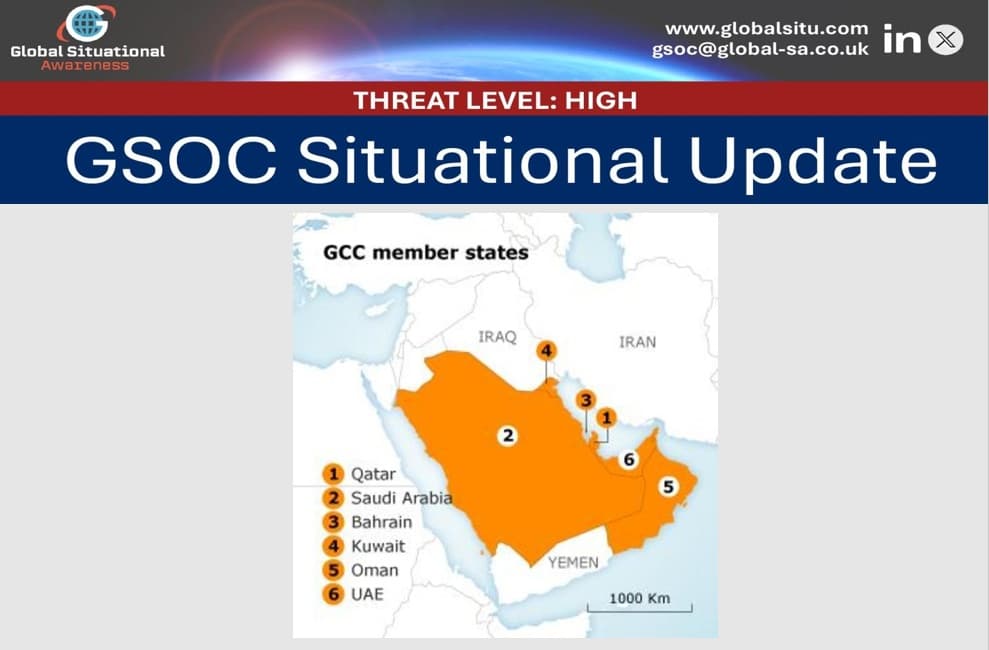
Leading global risk management firm, Global Situational Awareness has released a GCC Situational Update, with the threat level “high”, detailing US plans, the global market impact of Iran’s retaliation response which has been focused on infrastructure and logistical nodes, as well as military targets.
The update also covers the UK’s recent involvement to provide defensive support, and offers a comprehensive assessment and potential implications.
US Forces Worldwide
All American military bases are now on heightened alert, according to a U.S. official who spoke to ABC News. Bases worldwide are now at Force Protection Condition Bravo (FPCON Bravo), which Department of Defense policy defines as “an increased or more predictable threat of terrorist activity exists.” This is the highest level of security before an attack is considered imminent or likely, indicated by FPCON Charlie.
President Trump has announced the military operations will continue until all objectives are met. Trump claims 49 Iranian leaders killed, ‘big wave’ of strikes yet to come, describing the current campaign as only the beginning of a broader assault.
Global Market Impact
Due to military attacks on Qatar Energy’s operating facilities in Ras Laffan Industrial City and Mesaieed Industrial City in the State of Qatar, Qatar Energy has ceased production of Liquefied Natural Gas (LNG).
Move marks biggest disruption to energy supplies yet from the widening conflict in the Middle East. Sharp rise of 30% in LNG price in Europe and Asia as latest result as of 02 March 2026.
Oil price up 8% due to a near complete halt of shipments through the Strait of Hormuz – for which a 5th of global oil and gas flows. Comes after insurers began withdrawing coverage and number of vessels attacked including a Saudi Aramco carrying 500,000 barrels of oil. Saudi Arabia’s Ras Tanura refinery, which processes 550,000 barrels of oil a day, was also hit by UAVs in first attack on energy infrastructure in region. Multiple attacks raised the spectre of a prolonged energy price shock.
JPMorgan advises investors to buy the dip, calling the Iran escalation a short-term buying opportunity. The bank expects any oil spike to fade.
Targeting of Logistical nodes
In the short term, Iran is most likely to continue to target vessels in the Strait of Hormuz, critically disrupting oil and gas exports from the Gulf and triggering further price hikes on energy markets.
Qatar
Qatar Defence Ministry says its air force “successfully shot down” two fighter aircraft incoming from Iran.
Naval and air defence systems also took down seven ballistic missiles and intercepted five Iranian drones, the ministry said in a statement. “The threat was addressed immediately upon detection, in accordance with the operational plan, as all missiles were shot down before reaching their targets,” it said. Suggesting air-to- air combat occurred.
Saudi
The Saudi Ministry of Defence announces that five one-way attack drones were intercepted and destroyed approaching Prince Sultan Air Base. The Iranian forces’ targeting of Saudi Arabia’s Ras Tanura (Eastern province) refinery will possibly prompt retaliatory action in the coming days.
Iran
Iran is yet to replace Ayatollah Khamenei and it is unlikely that it would deviate sharply from his ideology and policies, potentially dampening the prospects for an enduring end to U.S.-Iran hostilities. As a result, Iran’s post-Khamenei power structure is unclear. President Masoud Pezeshkian has not been harmed in the strikes to date, but he is an elected reformist leader whose influence has always been sharply limited by the hardliners that dominate the regime. Before his death, Khamenei appointed hardline aide, Ali Larijani, the head of Iran’s Supreme National Security Council, to assume day-to-day management of Iran in the event of his death. Further complicating the leadership structure, the three-person interim leadership council comprises the sitting president (Pezeshkian), the head of the judiciary, Gholamhossein Mohseni-Ejei, and a member of the 12-member Guardians Council, which vets’ legislation for compliance with Islamic law. Ayatollah Alireza Araf, representative of the Guardian Council, and Ejei are avowed hardliners. They will likely clash with the more moderate Pezeshkian. The unknowns about Iran’s post-Khamenei power structure will no doubt cloud U.S. decision-making on whether and when to end the fighting.
Iraq
Baghdad is relatively stable at present, with one confirmed UAV strike since 28 February 2026, which was intercepted. Militia protests are ongoing but are yet to breach government security cordons. It is likely that pro-Iranian protests on Iraqi streets and targeting of US assets, Embassy and operations in Iraq, will ramp up in the next 48hrs. In the north, however, Erbil is sustaining significant attacks based on US force concentrated at the Erbil and Harir Airbases which at present is being underreported. Iranian-Kurdish dissidents based in Erbil/Sulaymaniyah are currently doing ground Ops against the IRGC in Western Iran. This raises chances of internal conflict between the various Kurds and the militias/Iran.
UK / Cyprus involvement
The US has been granted permission to use British military bases to launch attacks on Iranian missile storage depots and launchers, Prime Minister Sir Keir Starmer announced on Sunday. London has given approval for RAF Fairford in Gloucestershire and the joint UK-US military base of Diego Garcia in the Chagos Islands to be used by Washington, according to British officials. The UK prime minister said the move was “in line with international law”, as it underscored the “collective self-defence of longstanding friends and allies”, and would help safeguard British lives and interests. Gulf nations had urged London to do more to protect the region, he added. An hour after his statement, an unmanned attack drone hit the runway at RAF Akrotiri, Britain’s military base in Cyprus, UK foreign secretary Yvette Cooper confirmed on Monday. A Ministry of Defence spokesperson said: “Our Armed Forces are responding to a suspected drone strike at RAF Akrotiri in Cyprus at midnight local time. Our force protection in the region is at the highest level, and the base has responded to defend our people”.
Assessment
In the short term, the ongoing conflict in Iran will continue to create serious risks for travel and business in the Middle East and extreme caution should be taken when operating in Iran or any of the countries of the Middle East. Disruptions to international logistics including trade, maritime and aviation routes and hubs are expected in the short to medium term. Global financial and energy markets are also expected to be dramatically influenced on the stability or instability of the region.
It cannot equally be discounted that there is also a real possibility of a negotiated settlement leading to a ceasefire and leaving Iran’s political system largely intact. Possible renewed talks between the United States and the Iranian interim government could begin as early as this week, as President Trump wants to talk to the interim Iranian leadership. As was the case in the lead up to the conflict, it is unclear what type of negotiated settlement would be acceptable for the United States since President Trump’s objectives in Iran have shifted over time.
It remains highly unlikely at the moment that any popular movement to unseat the Iranian government by force will be successful this is despite President Trump calling on Iranian people to rise up. The entry of Iran’s proxies into the fray reflects the assessment that the war is an existential threat to Tehran. Other elements aligned to Iran in Iraq and Yemen cannot be discounted from firing further missiles and or drones towards Israel or US and British assets in the area following the latter’s involvement in the conflict.
For more Middle East news, click here