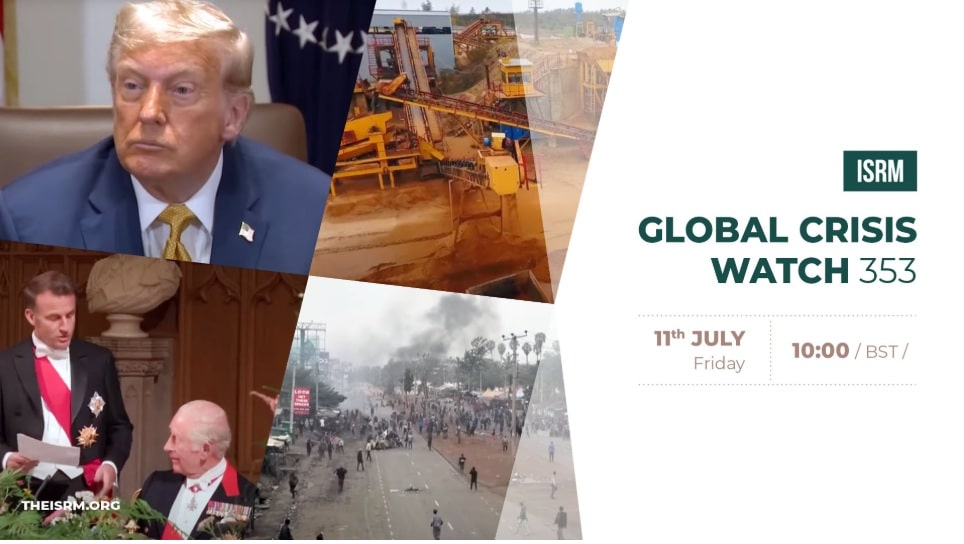
The Institute of Strategic Risk Management, (ISRM) has announced its latest Global Crisis Watch, number 353, taking place tomorrow, Friday, July 11, at 10:00 BST. It will cover topics, including Trump resuming arms to Ukraine, with President Zelensky welcoming renewed support, Trump pushing Gaza relocation plan and a new tariff row with South Africa, the conflict between China and Myanmar which is threatening rare earth minerals, King Charles III welcoming Macron to the UK, and anti-government demonstrations in Kenya which have seen hundreds arrested. Read more about the topics, and register, below.
Trump resumes Ukraine arms, pushes Gaza relocation plan and sparks tariff row with South Africa
Donald Trump has reversed a recent pause on US arms shipments to Ukraine, confirming that Washington will provide more “defensive weapons” to help Kyiv amid intensified Russian attacks. The announcement followed a week of deadly missile and drone strikes by Russia, including a major assault on the capital, Kyiv.
Speaking alongside Israeli Prime Minister Benjamin Netanyahu, Trump said he was “not happy” with Russia’s Vladimir Putin and acknowledged that Ukraine was “getting hit very hard”. The US had paused deliveries of critical systems like Patriot missiles and precision-guided shells last week, citing a Pentagon review prioritising “America’s interests”.
Ukrainian President Volodymyr Zelensky welcomed the renewed support.
In parallel, Trump has said that ceasefire talks between Israel and Hamas are “going very well”, despite Palestinian officials reporting no meaningful progress. Discussions in Qatar have reportedly stalled, and the Israeli government is pushing controversial plans for the forced relocation of Palestinians from Gaza.
Israel’s defence minister has ordered the military to prepare for the mass transfer of Gaza’s population to a “humanitarian city” in Rafah. The UN has condemned such proposals as potential violations of international law. Meanwhile, Trump and Netanyahu floated a longer-term plan for regional resettlement of Palestinians, causing widespread disapproval.
In another development, Trump announced a 30% tariff on imports from South Africa, sparking tension between Washington and Pretoria. South African President Cyril Ramaphosa criticised the move, calling it based on inaccurate trade data and warning of serious consequences for key export sectors.
Rare earths at risk as China wields economic leverage in Myanmar conflict
The global supply of heavy rare earths – vital for technologies like electric vehicles and wind turbines – is under threat as China attempts to influence the outcome of an escalating conflict in northern Myanmar. The Kachin Independence Army (KIA), a powerful ethnic rebel group, has been battling Myanmar’s junta for control of Bhamo, a strategic town near the Chinese border and key logistics hub.
China’s actions reflect a broader geopolitical aim – supporting Myanmar’s military junta, which it views as a more reliable guarantor of regional economic interests. The junta has used airpower to hold Bhamo, devastating the town and killing civilians.
China has also offered economic incentives, such as promises of increased cross-border trade, if the KIA halts its advance. Yet the KIA, hardened by decades of conflict, remains defiant, confident that seizing Bhamo could turn the tide of the war and force China to negotiate directly.
While Beijing calls for ceasefire talks, critics argue its moves are designed to protect mineral access rather than end Myanmar’s civil war. As fighting continues and humanitarian conditions deteriorate, the world watches closely – not only for the region’s future but for the stability of global rare earth markets.
King Charles welcomes Macron as UK and France renew post-Brexit ties
King Charles III welcomed French President Emmanuel Macron for a three-day state visit to the United Kingdom, marking the first official visit by a European leader since Brexit. The visit, filled with royal ceremony and political symbolism, aimed to reinforce historic ties and foster renewed cooperation between the two nations after years of Brexit-related tension.
In a banquet toast at Windsor Castle, the King praised the enduring Anglo-French friendship, upgrading the “Entente Cordiale” to an “Entente Amicale,” and stressing the need for unity in the face of complex global threats. The event included cultural gestures such as English sparkling wine produced by a French house and the announcement that the 11th-century Bayeux Tapestry will be loaned to the UK.
Macron, speaking in English to both Houses of Parliament, called for deeper UK- France cooperation on defence, migration, climate, trade and technology. He also urged British backing for Palestinian statehood, describing the two-state solution as the only path to peace in the Middle East. He reiterated strong support for Ukraine and warned against excessive reliance on the US and China, suggesting the two countries should “de-risk” their economies and societies.
Hundreds arrested in Kenya as anti-government demonstrations turn violent
At least 31 people were killed and more than 500 arrested during nationwide anti- government protests across Kenya on July 7th, according to the Kenya National Commission on Human Rights (KNCHR). The protests, held on “Saba Saba” Day – a historic date marking Kenya’s fight for multiparty democracy – drew thousands into the streets to denounce police brutality, economic hardship and President William Ruto’s leadership.
Protesters, many of them young, faced a heavy-handed police response, with reports of live ammunition, abductions and collaboration with armed gangs. The demonstrations are part of a broader youth-led movement that began in mid-2024, sparked by tax hikes and fuelled by anger over corruption, inequality and political repression.
The death of 30-year-old teacher and blogger Albert Ojwang has become a flashpoint. Ojwang, who had criticised the government online, died in police custody in early June under suspicious circumstances. Although police initially claimed suicide, investigations revealed signs of torture and led to the arrest of officers, sparking nationwide outrage and memorial protests.
Demonstrations in Ojwang’s memory escalated, and human rights groups, including Amnesty International, have accused authorities of fostering a culture of impunity and demanded accountability for the over 100 deaths since the protests began. There are also concerns about the targeted harassment of activists and human rights defenders.
Despite police denials and limited arrests of officers, many Kenyans remain unconvinced that justice will be served. With pressure mounting, the protests have become not just about policy, but about dignity, justice and the right to dissent in a democracy.
Register, and read the full topic breakdowns, here
For more ISRM news, click here