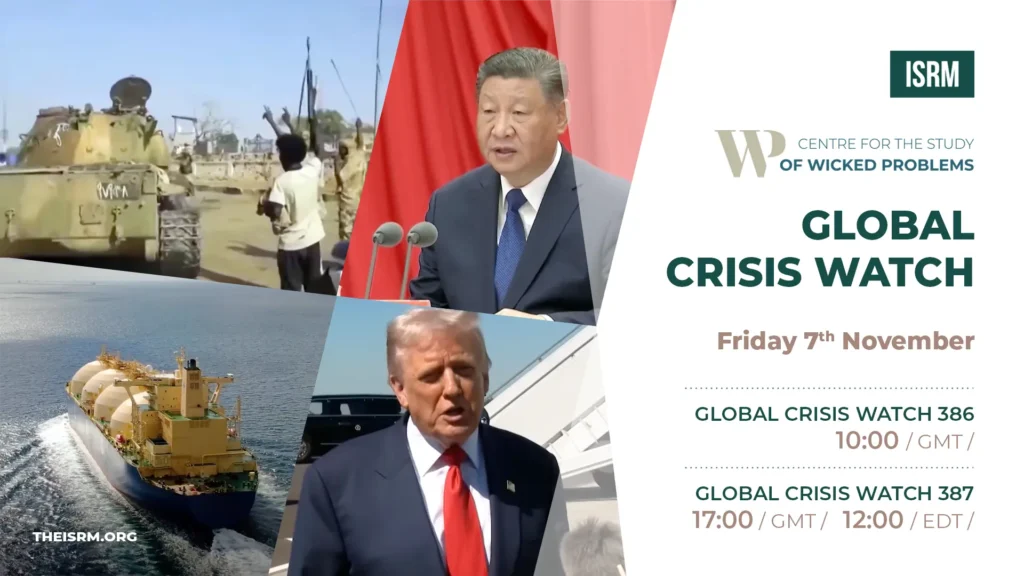
The Institute of Strategic Risk Management (ISRM) has announced its latest Global Crisis Watches, numbers 386, and 387, taking place tomorrow, Friday, November 7 at 10am BST and 5pm BST/12pm EDT. This week topics will include warnings of genocide in Sudan, Taiwan-China tensions, Europe facing energy crisis, and Trump’s dual focus of the NYC election endorsement and Nigeria intervention raise political stakes.
El-Fasher Falls as Sudan Faces Echoes of Genocide
The fall of El-Fasher in early November 2025 marks one of the darkest chapters in Sudan’s civil war. The city, the last stronghold of the Sudanese Armed Forces (SAF) in Darfur, was seized by the Rapid Support Forces (RSF) after an 18-month siege. Its capture triggered mass displacement, atrocities and warnings of genocide. According to the UN, more than 60,000 civilians have fled, while an estimated 150,000 remain trapped amid starvation, bombardment and ethnic violence.
UN agencies and rights groups report mass executions, sexual violence and child malnutrition among survivors. In a UN Security Council briefing on November 4, 2025, senior officials condemned the world’s “crisis of apathy”, warning that El-Fasher’s collapse mirrors the Darfur genocide of the early 2000s. Satellite images and survivor testimonies point to systematic killings of non-Arab civilians, recalling the tactics once used by the Janjaweed militias – the RSF’s predecessors.
Taiwan-China tensions and APEC 2026 spotlight regional risks
Tensions between China and Taiwan are rising ahead of the APEC (Asia-Pacific Economic Cooperation) summit in Shenzhen in November 2026. Taiwan has expressed safety concerns for its delegates, but China dismissed these, stating that participation depends on adherence to the “one China” principle. Taiwan, which joins as “Chinese Taipei”, has sought assurances of safety and equal treatment, highlighting growing strain in Taiwan-China relations. Beijing has continued military drills and increased naval patrols near the Taiwan Strait, signaling a firm stance ahead of the summit. Past APEC gatherings were held under more cooperative circumstances, but current tensions reflect broader geopolitical friction and the challenge of balancing economic engagement with security concerns.
Meanwhile, Asian financial markets faced turbulence on November 4, 2025. Japan’s Nikkei 225 and South Korea’s KOSPI dropped sharply as investors engaged in profit-taking after recent tech rallies, with SoftBank, Samsung and SK Hynix experiencing significant losses. In contrast, Hong Kong’s Hang Seng Index rose slightly, supported by a one-year US-China trade truce and strong local economic growth. China’s manufacturing sector showed continued contraction, signaling underlying weaknesses in the region’s economic outlook.
Europe faces energy crisis as Russian LNG phase-out collides with security challenges
As the Ukraine war continues, Europe faces a complex and interconnected crisis involving energy, defense and sanctions enforcement. The EU has accelerated plans to phase out Russian LNG (Liquefied natural gas) imports by 2027, aiming to replace them with supplies from the United States and Qatar. Officials argue the transition will have minimal impact on gas prices, yet the reality is more nuanced. Record Russian LNG imports continued through the first half of 2025, while European companies – including Baltic-based Fast Bunkering, Belgium’s Euronav and Germany’s Chemikalien Seetransporte – have been implicated in supplying Russia’s “shadow fleet”, undermining sanctions and highlighting the continent’s ongoing dependence on Moscow.
This energy paradox is closely linked to Europe’s broader security challenges. US troop withdrawals signal a strategic pivot, prompting European planners to expand rapid-response infrastructure, enhance readiness and ensure Ukraine receives critical financial support. The EU’s €17.7 billion investment in military mobility, the creation of the Baltic Defence Line and initiatives like Eastern Flank Watch are designed to reduce reliance on external powers while deterring Russian aggression. Yet these measures face a compressed timeline and require political cohesion among 27 member states to be fully effective.
Trump’s dual focus: NYC election endorsement and Nigeria intervention raise political stakes
US President Donald Trump has recently inserted himself decisively into two high- profile arenas, demonstrating his enduring influence on both domestic politics and international security. Domestically, Trump endorsed Andrew Cuomo, the son of former New York Governor Mario Cuomo. Andrew Cuomo served as New York’s governor from 2011 until his resignation in 2021 following multiple sexual harassment allegations. Trump threatened to withhold federal funding if Democratic candidate Zohran Mamdani wins Tuesday’s mayoral election. Cuomo, running as an independent after losing the Democratic primary, is framed by Trump as the only viable alternative to the 34-year-old democratic socialist, whom the president has repeatedly labeled a “communist”. Mamdani’s rise has energized younger and progressive voters while alarming moderates concerned about his proposals to raise taxes on the city’s wealthiest, increase publicly subsidized housing and freeze stabilized apartment rents. With federal contributions to New York City reaching $7.4 billion in fiscal year 2026, Trump’s threat highlights how federal funding can be wielded as a political instrument.
At the same time, Trump has escalated his engagement abroad, focusing on Nigeria, where he directed the Pentagon to prepare for potential military action in response to attacks on Christians by radical Islamist groups. While the Nigerian government insists both Christians and Muslims have been targeted, Trump framed the situation as an existential threat to the Christian population and suggested possible boots-on-the-ground intervention. His statements, issued via social media and private channels, caught many military officials by surprise, highlighting his unconventional approach of accelerating attention and action through high-profile public messaging rather than standard inter-agency coordination.
Register and find out more about the topics, here
For more ISRM news, click here