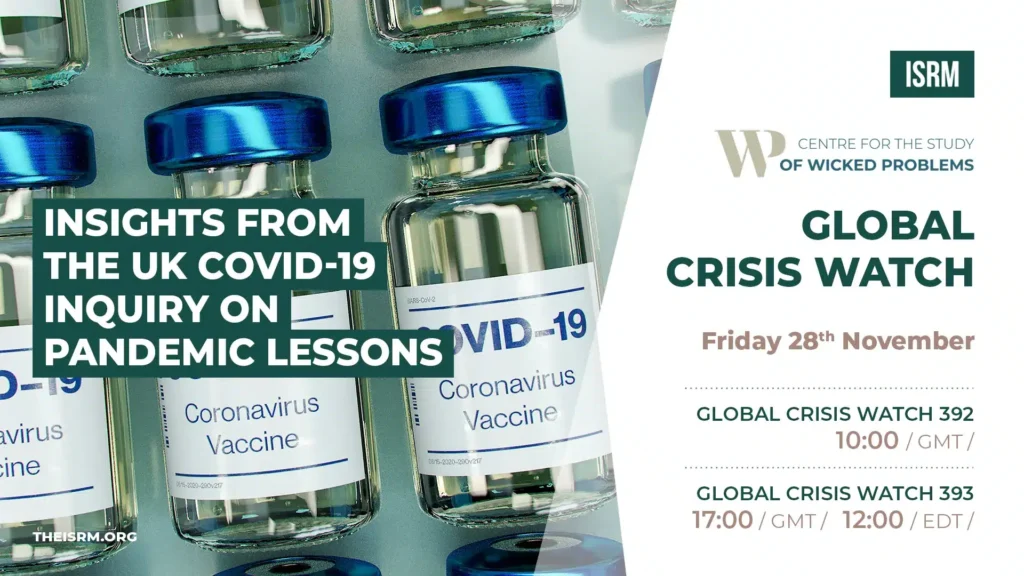
This Friday, November 28, the Institute of Strategic Risk Management (ISRM)’s Global Crisis Watch episodes 392 and 393, will take an in-depth look at the long-term societal and policy impacts of COVID-19, guided by the findings of the newly released UK COVID-19 Inquiry report.
Chaired by former senior judge Baroness Heather Hallett, the 800-page report provides a critical assessment of how the UK and devolved governments responded during the early stages of the pandemic. Its conclusion is clear: a faster and more decisive response could have saved thousands of lives.
The review finds that delaying the first nationwide lockdown until 23 March 2020 contributed to approximately 23,000 avoidable deaths during the first wave alone. The report describes the response as “too little, too late”, noting that similar mistakes were repeated later in 2020, compounding the impact on public health.
Key findings include:
- A lack of urgency and delayed recognition of the crisis in the first weeks of the outbreak
- Failure to account for asymptomatic transmission, which meant decision-makers underestimated the virus’s spread
- Confused leadership, inconsistent decision-making and weak restrictions
- Insufficient attention to the needs of vulnerable groups during lockdowns
The Inquiry’s conclusions have resonated strongly with families who lost loved ones, many of whom are calling for urgent reforms. British Prime Minister Keir Starmer has indicated that the government will carefully review the report’s recommendations, including enhancing parliamentary oversight of emergency powers, improving public health preparedness and ensuring decisions consider the most at-risk populations.
For the ISRM, these findings connect back to the origins of Global Crisis Watch itself, which grew out of its Coronavirus Campfire programme, launched in March 2020. This global initiative allowed participants worldwide to share experiences, challenges and insights, culminating in four detailed reports documenting lessons and best practices from the first year of the pandemic. GCW continues this collaborative spirit, transforming shared learning into structured discussions and reflection.
To enrich the discussion, the ISRM team is joined by two distinguished ISRM Fellows: Christine Miller and Guy Collyer.
- Christine Miller brings decades of experience in pandemic preparedness, crisis management and organisational resilience. She has planned and facilitated exercises for pandemics, supported recovery efforts after major emergencies and consulted internationally for organisations including the World Bank Group and the Asian Development Bank. Christine is also the first female President of the Australasian Institute of Emergency Services.
- Guy Collyer, ISRM Fellow and Chief Operations Officer, and former Head of INTERPOL’s Bioterrorism Prevention Unit, brings extensive expertise in bio-security, crisis management and multi-agency coordination. His experience spans global training, security and public health collaboration, offering insights into how COVID-19 intersects with crisis governance, global health and organisational resilience.
Join us on 28 November for GCW sessions 392 & 393, where Miller, Collyer and everyone attending the sessions will explore what these findings mean for future crisis governance, public trust, policy planning and global resilience. This is a unique opportunity to engage with critical lessons from the pandemic and understand how governments, organisations and communities can better respond to future crises.
Register, here
For more ISRM news, click here