Jawad Fares is a Security Manager and Consultant working to protect high profile buildings in the United Arab Emirates. In this exclusive interview, Peter Mawson met up with him at a restaurant to talk about his life, his role in helping to secure the facility and streets around where he operates, the ways in which AI technology is being implemented, and the role it plays.

Jawad Fares, of Palestinian heritage, has had a varied and storied career. He began his working life for the Palestinian Authority in 2007 after attending Dubai Police Academy, before gaining a university BA degree in Law and Police Science, and eventually moving to the UAE, where he moved into End User security-based roles, building his experience and developing his knowledge. Jawad has also worked as a close protection officer, providing security for high-profile celebrities during visits to the UAE.
One of Jawad’s key specializations, alongside security operations, is Crime Prevention Through Environmental Design (CPTED), or, in other words, manipulating the environment and using architectural design and strategies to assist in the reduction of crimes, promote safety, security, and improved quality of life.
CPTED is an important element in the security protection strategy, but it is often not utilized properly due to the reliance on electronic systems or traditional physical security measures instead. Jawad supports the idea of embedding CPTED when designing new or renovating existing properties, ensuring that environmental design complements physical and electronic controls to enhance the overall physical asset protection.
I ask him what this means in practice. “I notice that this is a very open environment, which seems to be something that you champion. That seems to be a big part of what you advocate. How does this openness promote greater security?”
“Instead of relying always, or solely on CCTV, you can create a nicer, well-designed, open environment that promotes natural surveillance as part of the overall security strategy,” Fares explains.
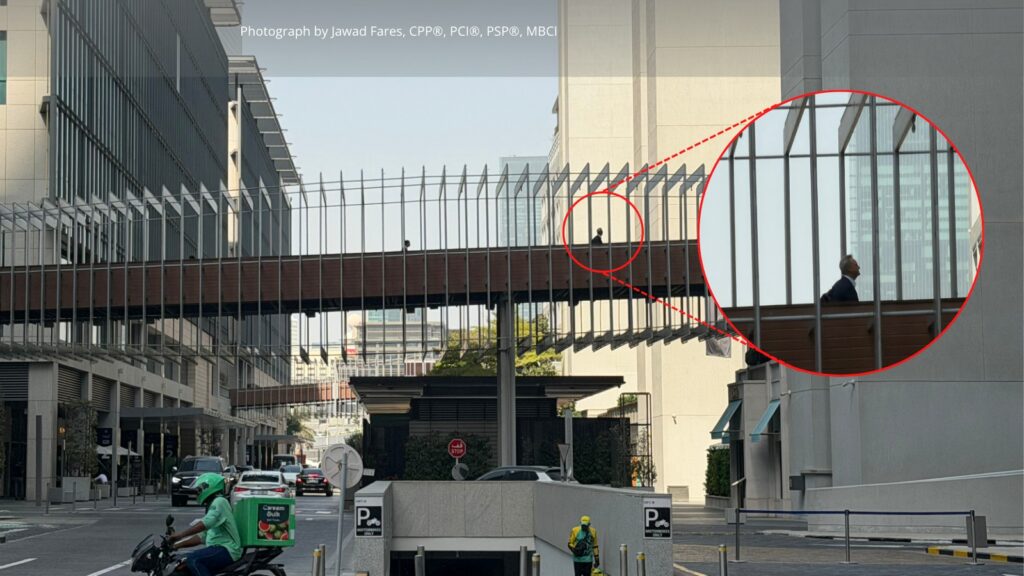
“For example, from a reception area in a commercial building, you should be able to clearly observe people entering and exiting the facility, which enhances the interior surveillance. Likewise, visibility between the interior of an office and the adjacent public space enhances visibility. Or, let’s say we are seated here, me and you now, and if you look around, you are all visible to each other. It’s designing crime out of the area, by making it far less attractive to commit a crime here, because you’re much more likely to be seen or caught. This increases the perceived likelihood of observation and intervention, thereby reducing opportunities for crime.”
He adds that this reflects one of the six physical CPTED strategies identified in ISO 22341:2021 — natural surveillance — alongside natural access control, territorial reinforcement, image and management/maintenance, activity support, and site/target hardening.
Jawad offers another example of the CPTED concept of natural access control by using landscaping — planting and grass verges — to create a subtle but effective buffer between safe spaces, such as a children’s play park, and potentially hazardous areas like a road. Instead of relying solely on hard barriers, natural street architecture can define boundaries while maintaining aesthetics and openness, and defining access through the use of landscaping. In some cases, hostile vehicle mitigation (HVM) measures such as bollards can be integrated as planters, and vegetation can be positioned around practical street furniture like lamp posts in townhouse communities.
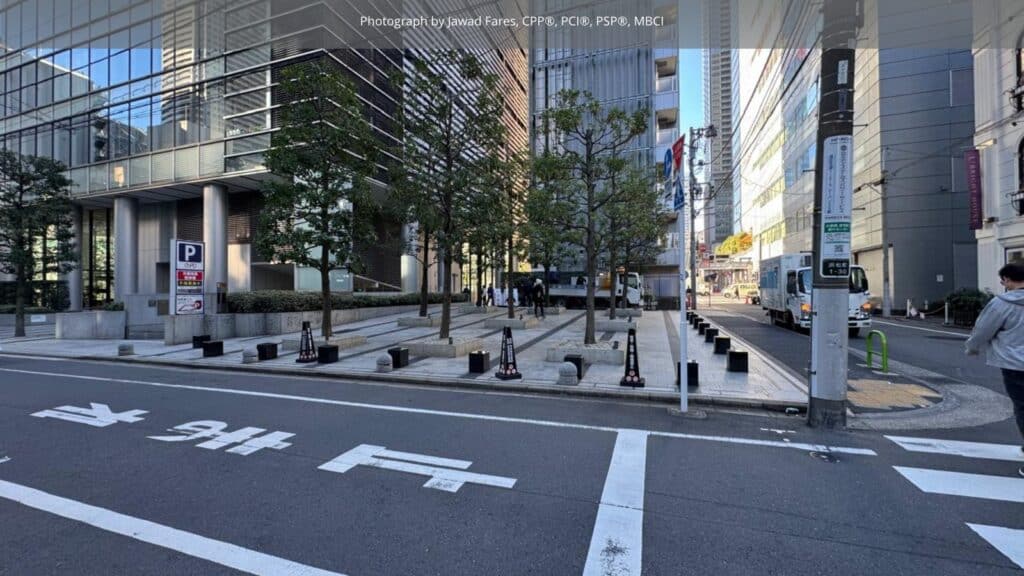
Beyond shaping the physical space, this approach also influences behaviour. Clearly defined planted areas (the use of low-growing plants no higher than 32 in. (81 cm) in height.) signal to children where safe play ends and the roadway begins. Visible, natural barriers assist motorists in maintaining spatial awareness and avoiding street furniture. At the same time, openness and natural surveillance increase the perceived likelihood of observation, making the environment less attractive for criminal activity.
“This practice involves considering security from the beginning and designing it into town or street planning, rather than it being an afterthought with lots of CCTV, (though this is essential for evidence gathering) and perimeter fencing, etc. It’s effective security, but doesn’t feel like it, because it’s a gentler approach.”
“This is crime prevention through environmental design,” he says.
So, could you explain a bit about how this could work in residential areas and how the psychology of this practice works? I ask.
“Sure. Residential areas are usually divided into four distinct zones as per Oscar Newman’s Defensible Space theory (1972): Public (the streets outside the gated community), Semi-public (the roads inside the gated community), Semi-private (the land directly outside the residential unit, such as any landscaping near the unit boundary or the interlock in front of the carport or infront of your door), and private (the residential unit itself).
For example, people can walk freely and do what they want, within reason, on the street outside the gated community, but if someone was to stand by your front door and stay there, or put something there, that would be intimidating, because they’re encroaching into your private space. So, you would naturally reach out to the security or the police, or to the person, and question them about their presence there.
The psychology behind this is territoriality. When boundaries are clearly defined through design, landscaping, pathways, lighting, or changes in material, residents instinctively recognise ownership. They feel responsible for that space and are more likely to challenge unusual behaviour. At the same time, potential offenders perceive a higher likelihood of being noticed.
It’s the way you feel and behave about the environment in each zone, and how the environment is built around you. If the environment is well maintained and clearly structured to reflect these zones, informal guardianship increases and crime opportunities decrease.
“But, if you go to an area where those lines are blurred – by graffiti, broken doors, windows, fences, or bushes blocking views, etc., then you attract a higher level of criminal activities due to the absence of management and maintenance elements. It is important to remove or repair obvious signs of property damage as quickly as possible.
But you don’t make it look like a castle, you know, you design it in such a way that it’s welcoming and at the same time it’s safe. The core of your CPTED strategy and the required protection level should be based on a security risk assessment (SRA).
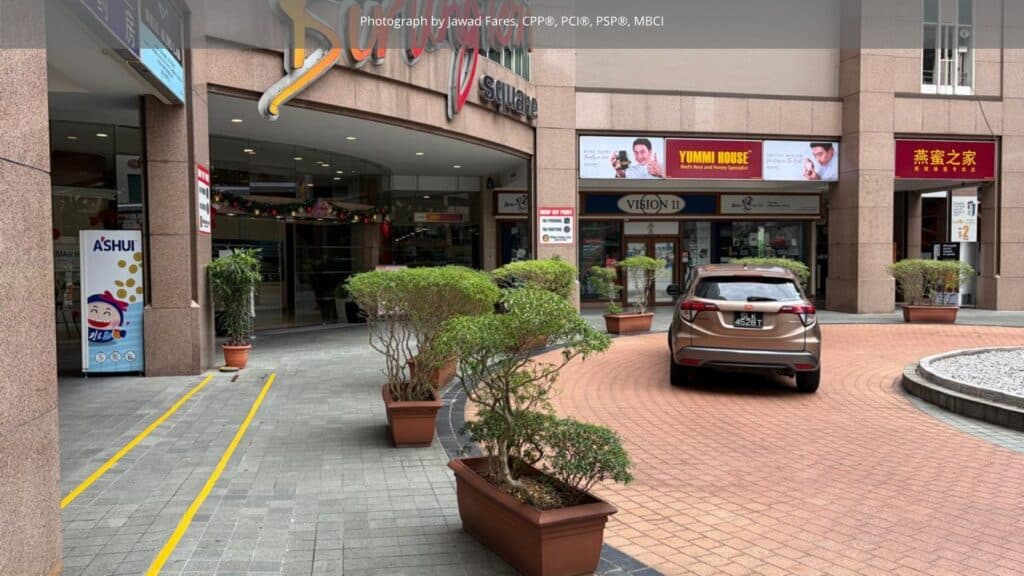
This approach to using the built environment is a very nice front face for the populace, I say, but at some point, technology comes into its own as well, albeit dampened down, perhaps because of the environment that has been built it doesn’t need lots of cameras.
What’s your position on the smart cameras that we’re seeing more of in surveillance at the moment?
“The world is moving quickly towards more digitization, digital platforms, etc., and the more the tech becomes more advanced, the more we need to be ahead of it,” Jawad notes. “So, if the enemy is using AI, security must use AI as well.
“AI cameras can give you like additional features, helping to assist the guys on the ground. So, instead of having a security guard analysing the behaviour of an individual from an entrance, you could have a camera that reads the facial expression, and you can build on it if you continue to monitor that individual based on any flagged behaviour to try and determine what his next actions might be and whether an intervention by the security team is necessary.
“And it’s not only monitoring, AI analysis can provide security teams with insights in order to better assess any potential threat so you can mount the right response force to deal with that individual. So, I think there’s definitely a place for the technology, even if it is still developing in some cases, with some margin of error. And of course, you always need that human analysis on the other side of the camera, but there are some very useful tools on the market.”
For more recent news, click here