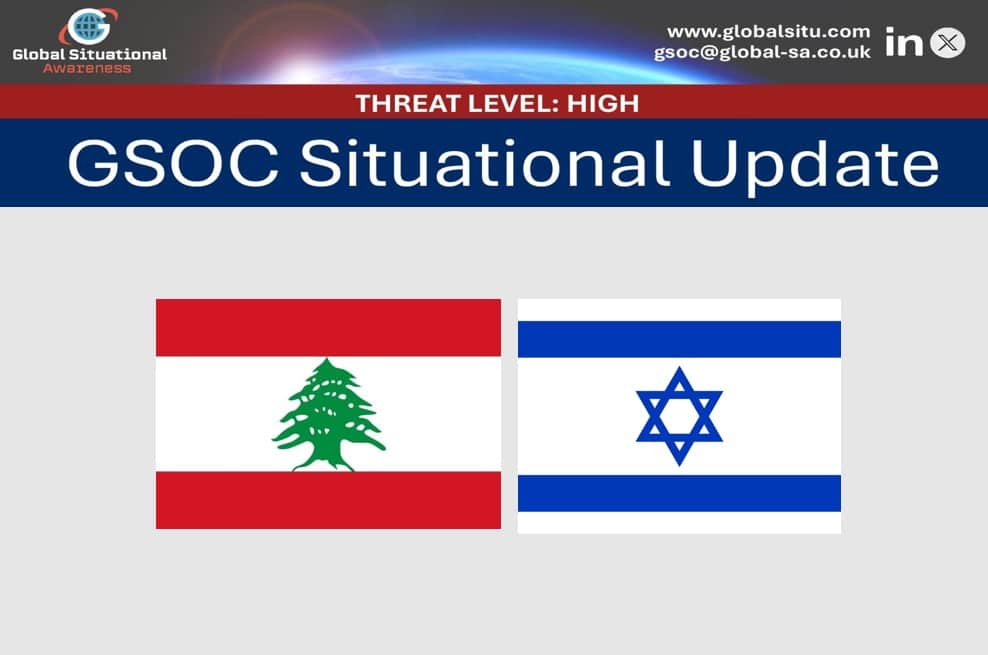
Geopolitical intelligence risk advisory firm Global Situational Awareness has released a GSOC situational update, listing a ‘high’ threat level, following reports that on March 2, 2026, the Israeli Defense Force (IDF) began a series of airstrikes against Hezbollah forces in Lebanon, after the group launched projectiles toward northern Israel. Here, the company offers a comprehensive report on the actions, as well as an assessment of the situation.
What is happening?
On 02 March 2026, the Israeli Defense Force (IDF) began a series of airstrikes against Hezbollah forces in Lebanon, after the group launched projectiles toward northern Israel. Unverified reports suggest there were explosions in Kiryat Shmona, Safed, Haifa and near northern military installations. This action triggering continuous sirens across the Galilee, Golan Heights, and Haifa areas.
Israel’s Iron Dome and David’s Sling systems were actively engaged and there have been reports of the first use in combat of the ‘Or Eitan’ laser system to intercept UAVs.
In response to the Hezbollah attack, there have been at least two waves of Israeli air strikes across Lebanon. IDF Chief of Staff Eyal Zamir claimed his forces struck the group’s sites including in the eastern Bekaa region, southern Lebanon, Deir Aames and in Beirut. These retaliatory strikes are thought to currently be focused on Hezbollah missile infrastructure and command nodes in Beirut’s Dahiyeh neighbourhood and headquarters and Southern Lebanon.
Hezbollah claimed responsibility for launching attacks targeting a military site south of Haifa in response to Iranian Supreme Leader Ayatollah Ali Khamenei’s death. It added that Israel “cannot continue its 15-month- long aggression without a warning response,” which they described as a legitimate act of self-defence.
Unverified reports are indicating that the Head of Hezbollah’s Parliamentary faction, Mohammad Raad, was killed in an Israeli airstrike in Beirut.
Lebanon’s Minister of Justice Adel Nasar has ordered the security apparatus to arrest those responsible within Hezbollah for the cross border missile attack and the Lebanese Prime Minister Nawaf Salam issues ban on Hezbollah, to be enforced by Lebanese military and stated that he will not allow Lebanon to be dragged into “new adventures.”
On 02 March 2026, the IDF also issued a directive for residents of Lebanese villages near the Israeli border to evacuate, stating that those near Hezbollah operatives and installations would be at risk due to IDF operations.
Assessment
• The entry of Iran’s proxies into the fray reflects the assessment that the war is an existential threat to Tehran. Hezbollah’s active engagement significantly increases the likelihood of prolonged Israel-Lebanon exchanges.
• Israel refuses to rule out major ground offensive in Lebanon in response to this latest escalation from Iran’s proxy Hezbollah, however, a large-scale sustained ground invasion of Lebanon is assessed as unlikely at present.
• On 01 March 2026, the IDF claimed to have mobilised 100,000 reservists in order to bolster defences across all sectors until at least 12 March 2026.
• Evacuation orders remain in place across Israel as residents from Haifa northward have been instructed to remain in protected spaces due to sustained cross-border exchanges.
• Israeli airspace is assessed to be set to gradually reopen from the evening hours on 02 March 2026.
• Hezbollah’s stronghold in Beirut’s Dahiyeh and in areas south of the Litani River are the most likely areas set
to continue to see reciprocal airstrikes from the IDF.
• Reiterate heightened vigilance in the Bekaa Valley and the southern suburbs of Beirut.
• Reiterate heightened vigilance around northern and Central Israel.
• Following the 28 February 2026, start of this conflict and recent indications that US President Trump is willing to talk to new Iranian officials, developments on the ground show that the escalation is expanding to rapidly include Iran‑backed militias regionally.
• Other elements aligned to Iran in Iraq and Yemen cannot be discounted from firing further missiles and or drones towards Israel or US and British assets in the area following the latter’s involvement in the conflict.
• Israel has indicated it has planned for and is prepared to operate on a multi-front scenario, but the opening
of a new front will increase the strain on Israel’s aerial defences.
Download the briefing below.
For more Middle East news, click here