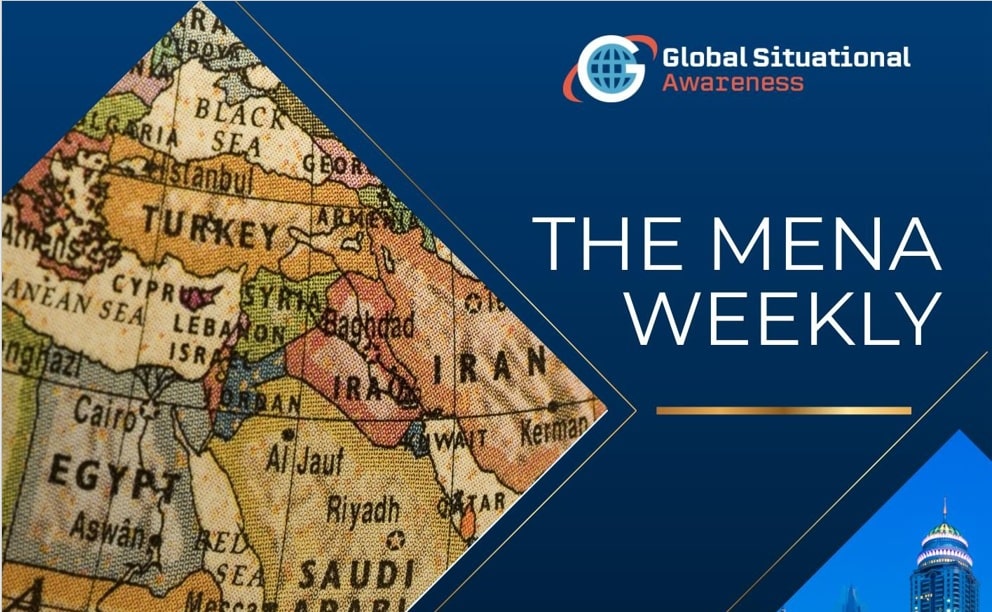
In its latest MENA Weekly briefing for the week ending Friday, June 12, Global Situational Awareness details all the latest developments in the Middle East region, including the US striking Iran after military a helicopter was shot down, and Iran’s retaliation, Netanyahu calling off major Iran strikes after a warning from Donald Trump, Iraq and UAE pushing alternative oil routes away from Hormuz, the UK and allies sanctioning networks that are enabling settler violence, the US strike on the sanctioned oil tanker MT Marivex in the Gulf of Oman, press freedom crackdown intensifying with journalist sentencing, and more. Below is an extract, with the full report available for download.
Iran — US strikes Iran after military helicopter shot down, Iran retaliates — SEVERE
Situation Update
On 08 June 2026, a United States (US) Apache helicopter was shot down by Iran in the Strait of Hormuz. The two crew members survived and were rescued by an American sea drone. US officials believe Iran used a drone to launch the attack. Following through on US President Donald Trump’s threat to “respond”, US forces carried out a series of strikes on Iranian military and surveillance sites. Among the targets were air defence systems, ground control stations, and radar sites near the Strait of Hormuz. On 09 June 2026, the Islamic Revolutionary Guard Corps (IRGC) said US strikes had damaged a telecommunications tower and two water tanks, and added the US had targeted the cities of Jask and Sirik, as well as Qeshm, an island in the Gulf. US Central Command (CENTCOM) called the strikes “a proportional response” for the Apache helicopter downing; the IRGC called the move “vicious”. In response, the IRGC announced that it had launched strikes on 21 targets at US bases in the region, one in Bahrain and the other in Jordan, while Kuwait’s army said it was also intercepting an attack. Since then, Trump has said that the US will take control of Iran’s oil and gas infrastructure and launch further strikes on Iran.
Assessment/Impact/Business Implications
The flare-up between the US and Iran comes after Israeli forces carried out strikes across southern Lebanon on 09 June 2026. Tehran had warned that Israeli attacks on southern Lebanon would trigger another wave of retaliatory strikes. With Trump subsequently writing on social media that Iran must “pay the price” for taking too long to negotiate, the state of diplomacy between opposing sides is potentially at its worst since the imposition of the ceasefire agreement on 08 April 2026. Iran’s targeting of Kuwait, Bahrain, and Jordan demonstrates a continuation of Tehran’s strategy of broadening the conflict and punishing other countries in the Gulf. While it remains unclear whether diplomacy can be resumed after the latest intensification, it is important to note that previous escalations and ceasefire breaches have not prevented a subsequent return to negotiations. Whether anything comes of further talks, should they be resumed, remains similarly unclear. With Trump earlier in the week warning Israeli Prime Minister Benjamin Netanyahu that he would be “on your own very soon”, the probability of Trump pulling out without an agreement is increasing. Although the highly undesirable nature of such an outcome means Washington will likely keep trying to find a resolution in the short-term.
Israel/Iran — Netanyahu calls off major Iran strikes after Trump warning — SEVERE
Situation Update
On 08 June 2026, Israeli Prime Minister Benjamin Netanyahu called off a major strike on Iran after United States (US) President Donald Trump instructed him not to escalate the situation. In an address to the nation, he said the attacks would be halted “for now”, but warned that Israel would strike Iran and Hezbollah if it is attacked again. The development came after fighting erupted between Israel and Iran for the first time since the ceasefire took effect on 08 April 2026. Trump told reporters that he had warned Netanyahu to “be careful, or you will be on your own very soon”. Trump, who argued that Washington and Tehran were within days of a breakthrough clearing the way for talks on a long-term nuclear deal, feared that Israel’s actions could jeopardise the process. Iran has repeatedly warned that Israel’s actions would result in a collapse in talks.
Netanyahu finds himself in a difficult position, having been previously criticised by his election rivals for halting strikes on Beirut on Washington’s request. Even Netanyahu’s allies have taken issue, with National Security Minister Itamar Ben Gvir posting on social media: “Mr. Prime Minister, you said that a strong prime minister tells the president of the United States ‘yes’ when possible, and ‘no’ when necessary. This is the time to tell our friend, President Trump, ‘no’”. The criticism underscores growing tensions within Israel’s political system over the extent to which military decisions should be coordinated with its closest ally, the US.
Assessment/Impact/Business Implications
Although Netanyahu called off the strike on Iran, he has approved of further attacks on southern Lebanon, which are likely to antagonise Tehran. On 09 June 2026, the Israeli Defence Forces carried out strikes on the southern Lebanese city of Tyre. With Iran warning that it could hit Israel again if it did not stop attacks in Lebanon, while Israel has vowed to continue its campaign against Hezbollah, a cyclical spiral of escalation and temporary pauses could be set in motion in the short-term. While Trump has confirmed his anger with Netanyahu, he remains unable to fully control Israel’s military actions. Despite Netanyahu having acquiesced to previous requests, with domestic criticism growing over such decisions, Netanyahu may feel it necessary to project an image of strength. With elections scheduled for October 2026 and Netanyahu performing poorly in the polls, such political considerations are only likely to become stronger in the coming weeks.
Download the full report, below
For more Global Situational Awareness news, click here