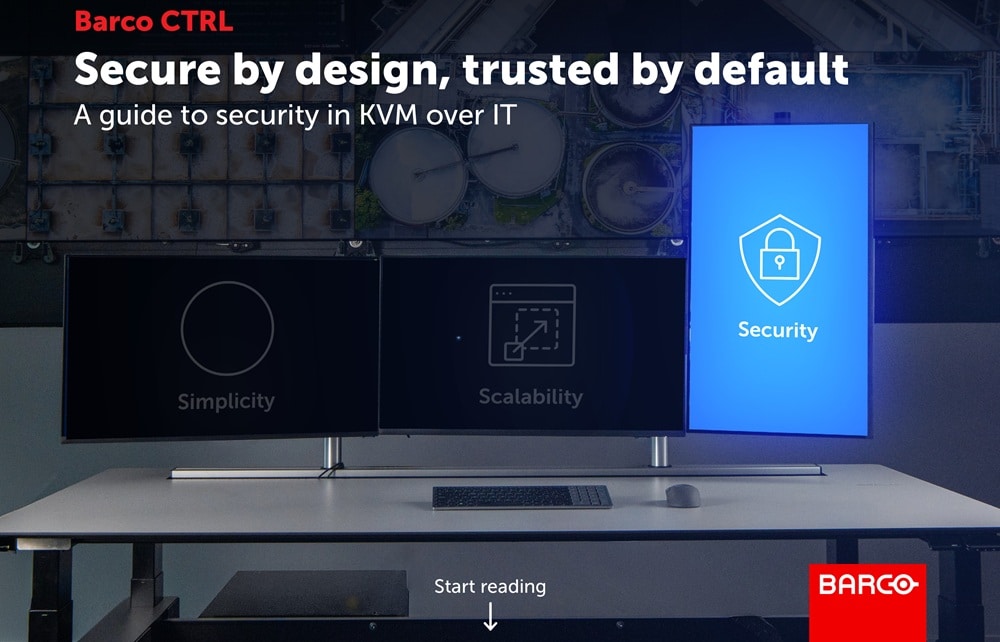
In a recent blog on its website, Barco details how, in critical infrastructure environments, a security breach is never just a problem of the organization concerned. Power grids go dark. Transport networks grind to a halt. Emergency services lose situational awareness. The decisions made in control rooms have real consequences for real people, which makes those rooms an increasingly attractive target for sophisticated threat actors. At the same time, the growing connection between IT systems and operational technology is creating new vulnerabilities that older platforms were simply never built to handle. This is an extract of the piece, which has an associated e-book. The link to the full piece and e-book are below.
Barco CTRL, the KVM over IT solution for control rooms, was built for exactly this reality. Security is not an add-on here. It is the foundation on which every other capability rests.
Security by design
Barco CTRL was designed from scratch following Security by Design principles – meaning security shaped every architectural choice from day one, rather than being layered on afterward. This is complemented by a Zero Trust architecture, where nothing is assumed safe by default: every user, every device, and every connection is verified, every time.
The platform’s security rests on five clearly defined pillars: identity management, communication protection, system protection, audit logging, and media protection. Together, they create a layered defense with no gaps – covering everything from who can log in, to how data travels across the network, to what happens if a physical device is compromised.
Just as importantly, Barco CTRL is secure by default. Every installation starts in its most secure state, without requiring any additional security setup from the installer. Unnecessary services are disabled, all communication is encrypted from the moment the system comes online, and no default passwords are left in place. Security that depends on correct configuration is security that can fail. Security built into the default state simply works.
Security in operation
Understanding that delayed patching is one of the most common (and most preventable) causes of security breaches, Barco CTRL makes updates as easy as possible. Patches roll out automatically across the entire installation from a single central location, reaching every device in one action, typically in no longer than a coffee break. No manual visits to individual hardware components, no extended downtime, no organizational anxiety about whether every device has been updated.
Close up of a person typing on a laptop keyboard with a digital lock overlayed. Illustrates cybersecurity, data protection, online safety, and the importance of secure internet practices in the digital age.
Behind the platform is a dedicated in-house security team – not a compliance checkbox, but engineers and architects embedded in every development team, with weekly security meetings to ensure vulnerabilities are caught and addressed before they ever reach a deployed system.
And because a system that goes down creates exactly the kind of high-pressure situation where mistakes are most likely to happen, Barco CTRL treats operational continuity as a security feature in its own right. Redundancy of the server means that when this hardware device fails, a spare takes over automatically. If one software service malfunctions, the rest of the system keeps running. Resilience and security, here, are two sides of the same coin.
Read the full piece and download the e-book, here
For more Barco news, click here