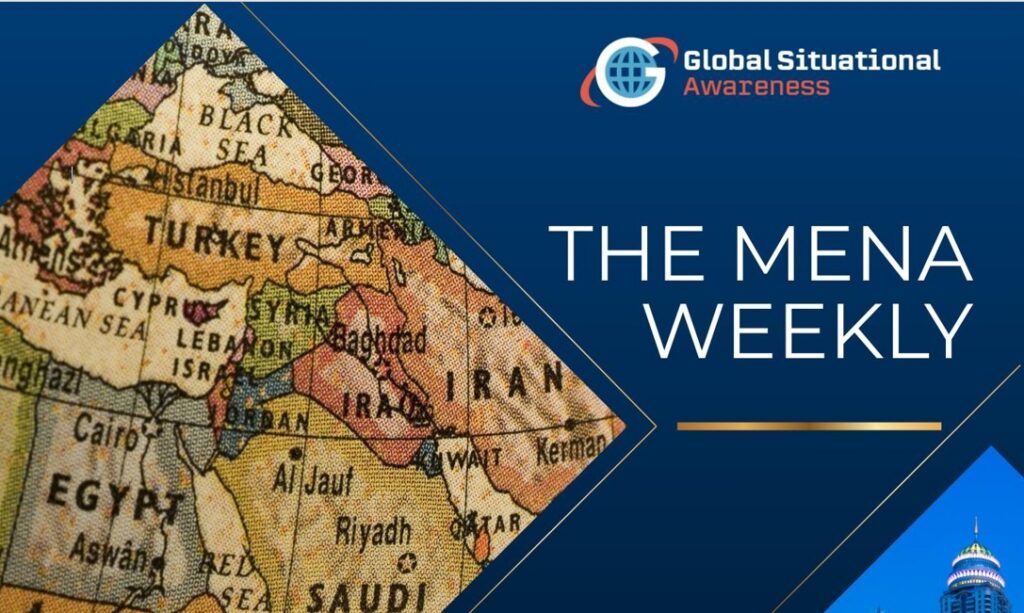
In its MENA Weekly briefing for the week ending May 1, geopolitical intelligence risk advisory firm Global Situational Awareness focuses on the latest developments between Iran and the US, including Trump reviewing an Iranian proposal aimed at reopening Strait of Hormuz, Israel and Hezbollah exchanging threats as strikes continue, Bahrain revoking citizenships over “glorifying” Iranian attacks, UAE announcing its withdrawal from OPEC, and more. Below is an excerpt with the full piece available for download.
Trump reviews an Iranian proposal aimed at reopening Strait of Hormuz – SEVERE
Situation Update
United States (US) President Donald Trump’s national security team is reviewing an Iranian proposal aimed at halting its joint war with Israel, reopening the Strait of Hormuz, and delaying negotiations over Tehran’s nuclear programme until after the war ends. While the White House has confirmed that Trump met with his national security advisors on 27 April 2026 to discuss the plan, reports have emerged suggesting that he was dissatisfied with the proposal to delay talks on Tehran’s nuclear activities. With Trump preferring to address the nuclear issue at the start of any negotiations, sources familiar with the matter considered it to be unlikely that he would accept the plan.
The proposal comes amid ongoing uncertainty surrounding shipping through the Strait of Hormuz, which has been significantly disrupted as a result of the US-Israeli war on Iran. Iranian President Masoud Pezeshkian has said Tehran will not enter negotiations while the US maintains restrictions on Iranian ports. Although over a month of fighting was brought to a pause by a ceasefire agreement on 08 April 2026, Trump recently cancelled an envoy trip to Pakistan to discuss peace talks.
Assessment/Impact/Business Implications
With diplomatic progress grinding to a halt and the Strait of Hormuz still closed, significant concerns remain globally. The two sides still appear to be at odds and the apparent lack of urgency from Washington to resolve the situation does not bode well for those worst impacted by the energy crisis. A growing list of nations has been forced to implement restrictions in an effort to prolong energy reserves as exports from the Middle East have dropped. Dozens of countries have called for the Strait to be reopened, with United Nations Chief Antonio Guterres warning that the standoff could trigger a global food emergency due to the waterway’s critical role in the global fertiliser supply chain.
If the situation continues in a similar manner, energy prices will remain high and unstable, forcing a greater number of countries to implement increasingly strict rationing and conservation measures. Crop yields will be negatively impacted due to fertiliser shortages, contributing to humanitarian crises in developing nations. Additionally, as global pressures mount, including on those involved in the conflict, the likelihood of the war resuming could increase. This is because the US and Israel may feel that triggering regime change is the only way to reopen the Strait without surrendering to undesirable terms. Alternatively, with some assessments warning that Iran’s economy cannot withstand more than six to eight weeks of a naval blockade, Tehran may pursue an escalation out of desperation in an effort to break the siege and prevent the regime from falling.
Download the full piece below
For more Middle East news, click here