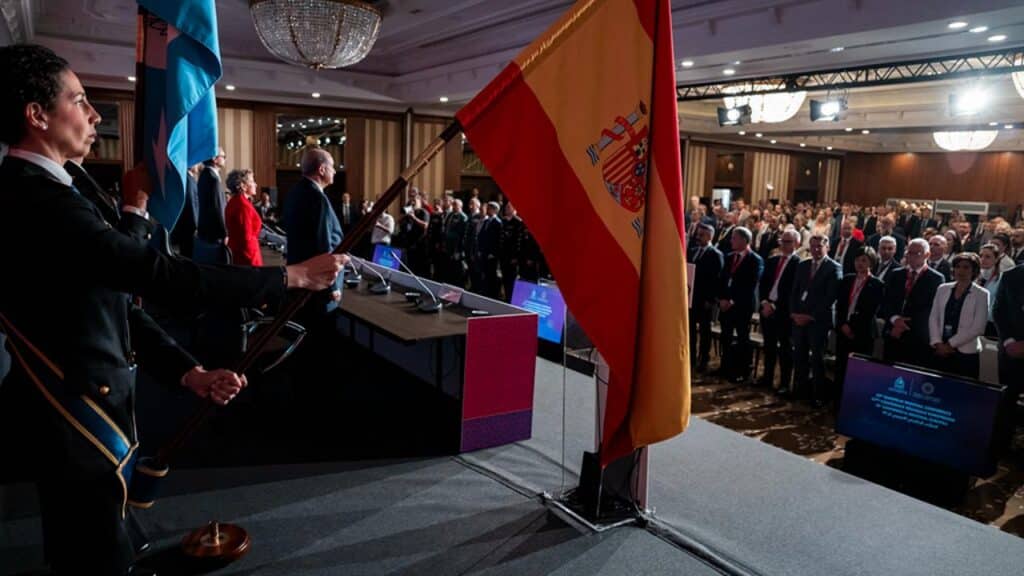
INTERPOL’s regional conference brought together more than 140 senior police officials from Europe and beyond to address drug trafficking routes stretching from Latin America into European ports, fraud operations targeting victims from other continents, criminal groups infiltrating legitimate businesses and more.
During the two-day (20 and 21 May) meeting, delegates examined how criminal networks are increasingly exploiting digital platforms, with crime-as-a-service ecosystems and industrial-scale scam centres posing a growing threat, facilitating cyber-enabled fraud and financial crime on an unprecedented scale.
“It is a great honour to host this event in Spain, a country that promotes international police cooperation and recognises the strategic value of INTERPOL and the professionals whose daily work supports the security of millions of people,” Aina Calvo Sastre, Spain’s Secretary of State for Security said. “At a time when globalisation has created new opportunities for transnational crime, strengthening bilateral and multilateral cooperation is essential to addressing shared threats such as cybercrime, drug trafficking, irregular migration networks and hate crimes.”
“The strength of INTERPOL lies in its ability to turn different systems and perspectives into a shared operational language for global policing,” INTERPOL President Lucas Philippe added. “These two days must not be just a diagnostic exercise.
“They must be a space for action – a space where we consolidate our cooperation reflexes and reinforce the common operational language that has been INTERPOL’s true strength for more than a century.”
Borderless crime and invisible threats
“Today, the most dangerous criminal infrastructure is borderless and invisible, operating from anywhere in the world, day or night,” INTERPOL Secretary General Valdecy Urquiza said. “International crime has local consequences, and we see how national and regional policing is strongest when amplified by global intelligence, capabilities and connectivity.
“And here, Europe leads by example, turning international police cooperation into operational results.”
Drug trafficking and illicit financial flows
The conference addressed evolutions in drug trafficking in Europe, such as changing routes and the increasing use of deep-water maritime corridors by organised crime groups.
Delegates were updated on how tools such as the INTERPOL Global Rapid Intervention of Payments (I-GRIP) stop-payment mechanism and Silver Notices are assisting member countries identify, trace and recover assets linked to criminal activity.
New operational responses to detect and disrupt human trafficking networks will also be explored over the coming days.
International cooperation resolves 25-year-old cold case
The meeting came at a significant moment for international police cooperation, following the recent identification of a 16-year-old girl whose body was discovered in the River Main in Frankfurt, Germany, in 2001.
This case marks the sixth successful identification linked to Identify Me, an international campaign coordinated by INTERPOL in partnership with authorities in Belgium, France, Germany, Italy, the Netherlands and Spain.
The initiative seeks to identify 47 women whose bodies were found across Europe over recent decades and to advance investigations into the circumstances surrounding their deaths
To read more INTERPOL news, click here.