HID Global’s news at The Security Event (TSE) 2026, included a major collaborative European case study, and the booth was attracting interest with new products. While digesting project descriptions, Security on Screen’s roving reporter Jeremy Malies also spoke to Jaroslav Barton, (pictured, below, right), Director of Product Marketing, Physical Access Control.

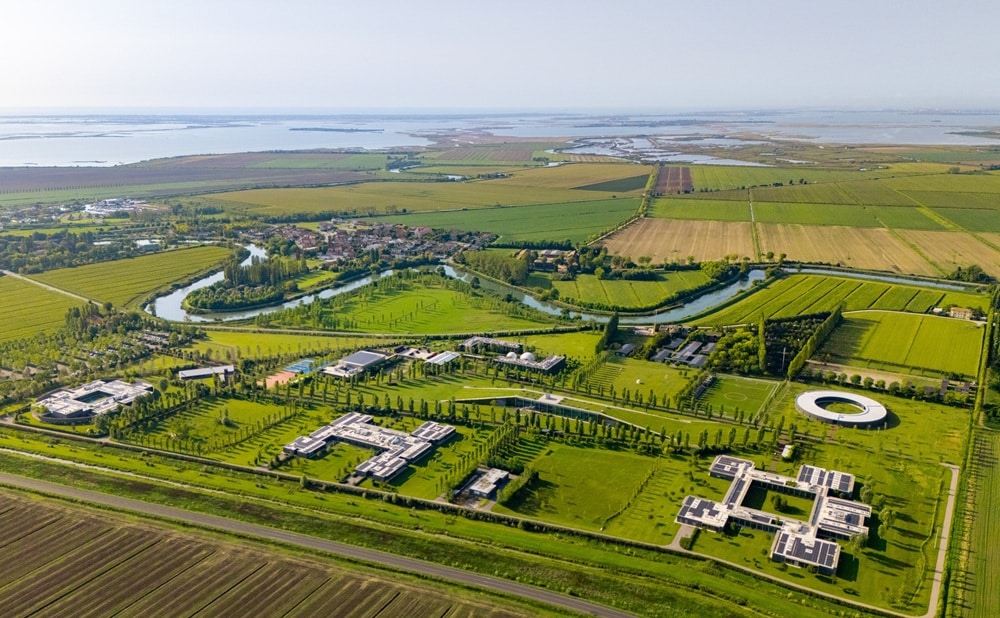
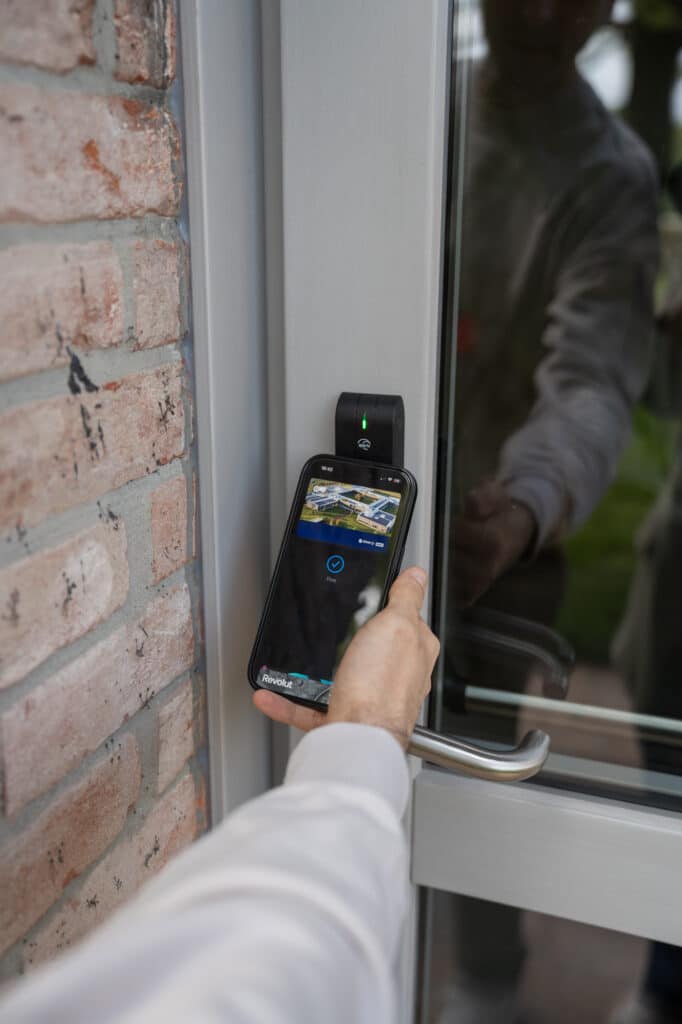
HID Global has introduced Digital Wallet student IDs to campuses in the US including Clemson University in South Carolina. But the company proudly outlined its first European application of the solution at H-FARM College in Italy. The technology is allowing students and staff to access spaces using their smartphones or smartwatches. The project sees HID working with Sharry, a Cloud-based workplace experience platform that deploys digital badges for frictionless but rigorous access control. The platform works with both App Store and Google Play.
The project site is in Roncade to the north of Venice. H-FARM College is in its twentieth year and supports students with entrepreneurial start-ups, notably by helping them with pitch competitions.
This successful digital-first implementation is a significant milestone for European higher education, notable for unifying smart access with a strict identity solution. Take-up from students (there are both undergraduate and postgraduate courses) as well as academic and technical staff has been enthusiastic. Seventy percent of students activated their virtual badge within three minutes of being notified about it, and there has been commitment along similar lines from staff.
Access areas include individual rooms, communal campus spaces, and breakout study areas. Crucially, the wallets allow users to explore the campus map, use printer stations, and pay for food & drink.
The HID infrastructure can be regarded as the credential issuance layer in this case study, allowing secure digital IDs to be provisioned and managed at campus scale. The integration means that campus users do not have to carry physical badges or even resort to other Apps in terms of their student life.
Jaroslav picked up on implementation demands in further education settings. He said, “H-FARM is a technology institution with many postgraduate students. Think of the sheer volume of student registrations that have to be processed at a traditional campus university, and usually in one month, notably September. Not only do first-years have to be registered with numerous details, returning undergraduates and postgrads must also have their information renewed.”
Jaroslav expands on the theme of credentials within smartphones and smartwatches. He notes that when a registered user loses or even mislays their phone, it is an easy matter to ask an administrator to suspend user privileges, even temporarily. All of this can be done remotely.
Additionally, it barely passes muster for anybody younger than early Generation X to say to somebody in authority that they have left the house of a morning without their mobile phone. Jaroslav also makes the point that the phenomenon of “buddy punching” (falsely identifying your workplace friend to a reader with their card or fob for time & attendance purposes) is unlikely to happen if the credential is one’s smartphone.

Our conversation extends to the sectors where cards, biometric credentials, and possibly smartwatches will all be acceptable forms of identification, but phone usage is simply inappropriate. This can be for reasons of productivity, safety (use of machinery) and need for absolute undivided attention in mission-critical work such as air traffic control. HID is also respected for its ability to work with consultants and end-users to select the right credential type for unusual sectors such as food preparation lines where fingerprint or even entering of a pincode might be problematic. In such environments, HID’s iris recognition (HID I Scan 3) can be particularly useful.
Always there must be a balance: good judgement between easy, frictionless ability to gain access to a facility and rigorous protocol. An obvious example might be a hospital where a specialist clinician could be summoned to the site urgently from elsewhere. He or she may need to go into theatre promptly but with no let-up on overall security measures.
Jaroslav mentions that data centres are another special case. Role-specific access control privileges are of course a given in any digital access control system and have been for decades. No vendor would boast about this now. But the granularity at a data centre will be exceptional in terms of appropriate access rights for staff according to their exact technical expertise, with multiple credential types and subtle combinations of these being in place. Single breaches can be catastrophic in terms of damage to reputation while downtime is equally grave.
The challenges at datacentres are diverse and are not just limited to corporate espionage and disaffected insiders. Simple theft of valuable components is a major item on the threat horizon. Surprisingly, given their sensitivity, it is common for datacentres to be housed within larger commercial premises with other business activities being carried on at the site. Even with exceptional in-house expertise being on hand at all times, external contractors must be used frequently so timeframes for visitor credentials becomes vital.
Returning to the theme of integration with Apple Wallet, Jaroslav mentions 22 Bishopsgate, a 62-storey commercial building in the financial district of the City of London. Widely publicized in the security press, including Security on Screen, three years ago, it is now a mature case study. But Jaroslav is right to reflect on it as an example of best practice. He describes the building as “an ecosphere” with a dedicated App and an environment in which one can attend a meeting on a particular floor, benefit from frictionless access, order a meal, and maintain complete focus on your own remit in the building on that day. As with H-FARM College, the solution uses Apple Wallet, this time the collaboration being between HID Global and Smart Spaces, a smart building solutions provider. 22 Bishopsgate was one of the first UK companies to introduce employee badges in Apple Wallet.
Interview Jaroslav and you will always be struck by a breadth of vision and a focus on ease of management for client organizations. He closes by reflecting on integration with video surveillance and smart building solutions as well as other disciplines, most notably fire alarms and fire suppressant measures. Interoperability will always be key, and collaboration with other vendors is at a premium.
For more HID news, click here