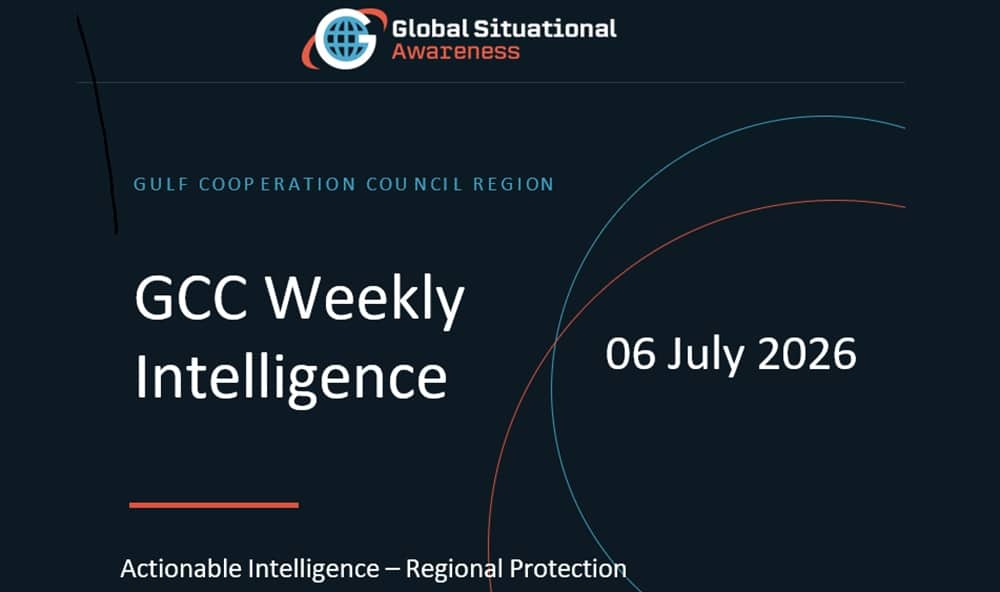
In this week’s GCC Weekly Intelligence report, to July 6, Geopolitical intelligence risk advisory firm Global Situational Awareness reviews the current Gulf risk picture, including maritime security around Hormuz and the Red Sea, aviation sensitivity, Qatar’s resumption of maritime activity, and country-level exposure across Saudi Arabia, Kuwait, the UAE, Oman, Bahrain and Qatar. Below is an extract, with the full report available for download.
The assessment also includes updated escalation triggers, watch items, positive stabilisation signals and a geopolitical look ahead for the coming weeks.
It details how the GCC environment has moved from immediate escalation risk into managed tension with selective recovery. Qatar’s maritime reopening, continued aviation activity and improving energy confidence are positive indicators, but the region has not returned to normal operating conditions.
The main change since the last report is maritime. Hormuz remains politically contested, while the latest vessel attack off Yemen’s Red Sea coast brings Bab el-Mandeb and Red Sea-linked cargo back into focus. Operators now face a two-chokepoint risk picture rather than a Hormuz-only problem.
Iran’s leverage over Hormuz remains central to the geopolitical outlook. UK-France readiness to support a maritime security force may reassure shipping, but it could also sharpen Iranian objections and increase tactical friction around the strait. Kuwait and Bahrain remain the most exposed GCC states. Qatar is improving but still vulnerable through LNG and Hormuz-linked tanker confidence. Oman’s diplomatic and maritime value is rising. The UAE and Saudi Arabia remain operationally resilient but exposed to aviation, maritime, energy and routing risk.
Looking ahead
The next phase is no longer defined by whether the GCC is reopening. It is defined by whether selective recovery can hold while maritime pressure spreads across two chokepoints. Qatar’s resumption of maritime activity, Opec+ output recovery and continued GCC aviation activity are positive signals. However, the latest vessel attack off Yemen shows that Red Sea and Bab el-Mandeb risk has re-entered the operating picture just as Hormuz remains politically contested.
This changes the geopolitical frame. The region is not moving from crisis to normality; it is moving from direct escalation risk into a more complicated contest over maritime leverage. Hormuz remains the central symbol because Iran and aligned voices continue to treat the strait as strategic pressure. At the same time, UK-France readiness to support a multinational Hormuz security effort introduces a new external-force dynamic. That could reassure shipping, but it could also create another point of friction with Tehran.
For the GCC, the recovery is uneven. Qatar has the clearest positive update because maritime activity has resumed, but LNG and Hormuz exposure still make it vulnerable to any renewed tanker caution. Oman’s value rises because Hormuz security and de-confliction increasingly depend on Muscat’s geography and diplomatic channels. Saudi Arabia benefits from stronger energy confidence, but Red Sea risk is now more relevant to western routes and cargo sentiment. The UAE remains commercially resilient, but aviation management, GNSS interference and maritime-routing risk remain active. Kuwait and Bahrain remain the most sensitive states because of geography, airspace exposure and security posture.
Next 72–96 hours: Watch whether the Red Sea attack remains isolated, whether Qatar’s maritime reopening holds, and whether Iran reacts to UK-France Hormuz security language. The most important indicators are not broad diplomatic statements, but practical signs: vessel warnings, port restrictions, insurer changes, airspace alerts, GNSS disruption, or new militia-linked pressure from Yemen, Iraq, Syria or Lebanon.
Next 7–14 days: The key question is whether maritime recovery becomes credible or stays conditional. If Qatar remains open, Hormuz transits remain clean and no further Red Sea attack occurs, confidence should improve gradually. If attacks repeat off Yemen, or Iran raises pressure through routing demands, control claims, naval signalling or fee language, operators will treat recovery as fragile even if ports and airspace remain technically open.
Next month: The wider geopolitical risk is that the Gulf becomes stable on paper but exposed in practice. US-Iran diplomacy may continue, but Hormuz, the Red Sea, Iraq-linked pressure, Syria diplomacy, Lebanon tensions and Yemen maritime activity can all disrupt the track. A multinational Hormuz security effort would be one of the most important developments to watch because it could either stabilise shipping confidence or trigger new Iranian resistance.
Download the full report, below
For more Middle East news, click here