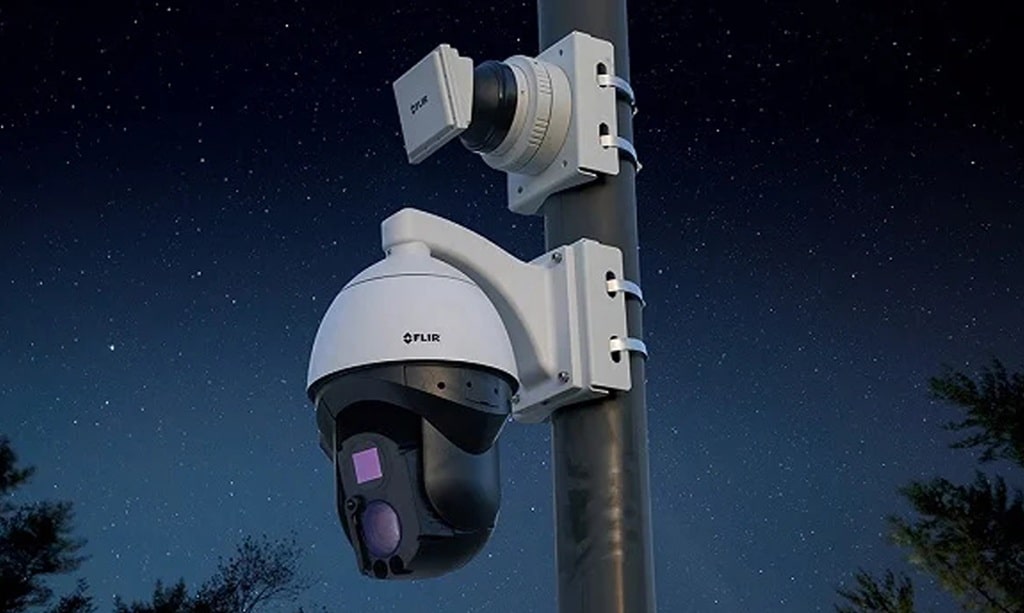
At The Security Event (TSE) this year, Security on Screen’s occasional roving reporter Jeremy Malies was pounding the show floor, visiting a selection of the interesting stands. Here, he visits the Teledyne FLIR booth and is given a tour by the company’s Regional Sales Manager for Security, Bob Groom.
“The array of products on the stand of Teledyne FLIR at The Security Event immediately strikes customers as a cohesive suite, but the offerings need to be seen from a perspective that lets you understand how they can operate together.
“Bob talked me through the ranges, looked ahead to likely horizons in terms of the whole industry, and explained concepts in digestible terms. As a further indication of a trend across the sector, the products here showed that the preferred approach for Teledyne FLIR is to have intelligence at the edge.
“He takes pride in the company’s ability to detect and then categorize objects such as humans (or a mammal of an approximate size to a human) and vehicles.
“My knowledge of conventional or white light cameras is intermediate, but I have much to learn about thermal imaging. Our conversation covers the subtlety of the factors that determine at what distances end-users should change from visible white light cameras to thermal. There is no fixed distance, and site-specific environmental conditions dictate decisions of this kind. But distances in excess of 50-100 metres seem to be the usual range at which customers switch to thermal. Installers and consultants will ask users whether they are seeking mere detection or categorization, and what time of day is their busiest or most challenging.
“An impressive aspect of the Teledyne FLIR offering is that there is minimal if any reliance on input from third parties. Even the algorithms in the on-board analytics used by the cameras have been developed by the R&D department. Bob reinforces the sector-leading ability of the software to detect and then classify. A major performance criterion is the minimizing of false positives by filtering out wildlife and legitimate visitors.
“Bob explains that how much you can “see” with a thermal imaging camera depends on what temperatures you can sense. We discuss the sensitivity of the cameras and I become puzzled. He appears to be describing an inverse relationship. The better a camera’s performance, the lower it seems to score in whatever unit he is using. Finally, the penny drops. The measurement, the Noise Equivalent Temperature Difference (NETD), expresses the smallest temperature difference that the camera can detect. Hence the counter-intuitive first impression. And the unit? NETD is expressed in milliKelvins (mK).
“The discussion moves on to fire detection and how cameras are used to detect the heat signatures of burning objects. There are of course significantly different needs in terms of resolution. Bob explains the concept of “bloom” or “blooming” whereby a flame or hotspot may overwhelm a sensor and spread into neighbouring pixels meaning that an area is misrepresented and can appear larger than it really is. This phenomenon must be minimized since fire fighters and other first responders need optimum situational awareness as they decide on tactics and assess possible escalation.
“Bob outlines the competitive advantages of Nexus. This is Teledyne FLIR’s own communication software that allows edge devices to share information in real-time without recourse to other software and servers. It is of value to clients relying on a broad array of the company’s devices to detect and track objects of interest and protect their perimeters.
Analytics is a frequent topic as our talk continues. Detection, measurement, and protection can only truly work with reliable identification and classification. Teledyne FLIR clients benefit from optimum protection of their perimeters through intelligent discounting of moving objects that are not a threat. Bob mentions that he has recently helped a client to distinguish between possible human intruders and Muntjac deer! I think the slight note of disdain in his voice is because this is a non-indigenous and disruptive species. I don’t inquire any further as to the location of the project!
“With the offering being so broad, the conversation covered a whole gamut, and Bob went on to discuss radar. The Teledyne FLIR suite empowers clients by offering radar-based solutions as an additional component in system design, particularly when adverse environmental conditions are a challenge for imaging (both thermal and white light). The stand at The Security Event included material illustrating the Elara™ R-Series for end-to-end perimeter intrusion detection systems that can generate the earliest possible threat warnings with dynamic mapping. I noted how other Teledyne FLIR staff on the booth were telling visitors about how radar combined with both kinds of camera imaging as well as a VMS can create an ecosphere of protection.”
To read more Teledyne FLIR news, click here.